
Explore evidence and perspectives on inclusion, meaningful youth engagement, and interdisciplinary innovation in research and digital mental health design. This learning path brings together patient and public involvement, co-design, participatory practice, and user-centered design to examine how people can influence research and development. Critically consider power, participation experiences, contextual barriers, and the limitations of different approaches, then connect these insights to more inclusive collaboration and evaluation in your own work.
Learning Outcome
By the end of this learning path, learners will be able to:
- Critically appraise evidence on inclusion and youth engagement in research and digital mental health design, distinguishing findings from recommendations and evidence gaps.
- Compare patient and public involvement, co-design, participatory design, and user-centered design, and justify their use in a given context.
- Analyze how power, participation burdens, accessibility, and organizational context influence meaningful youth involvement and interdisciplinary collaboration.
- Develop an evidence-informed plan for inclusive youth participation that specifies shared decision-making, participant support, and evaluation of the quality and influence of involvement.
1. Summary of the evidence
An introductory overview of the learning path’s evidence base on inclusion, youth engagement, and interdisciplinary innovation. Learners consider the main messages, reflect on evidence gaps, and connect emerging questions to their own research or design context.
Learning Outcome
By the end of this module, learners will be able to:
- Summarize key messages from the evidence presented on inclusion, youth engagement, and interdisciplinary innovation.
- Distinguish evidence-supported conclusions from areas of uncertainty.
- Identify implications of the evidence for planning inclusive research and design.
2. Understanding PPI in Youth Mental Health: Definitions, Roles, and the Research Lifecycle
Explore the NIHR definition of patient and public involvement and how involvement is defined and applied across youth mental health research. Drawing on Mendes et al. (2026), examine overlapping terminology and the importance of clearly describing young people’s roles, influence and involvement across the research lifecycle.
Learning Outcome
By the end of this module, learners will be able to:
- Explain the definition of PPI using the NIHR definition and distinguish between participation and involvement in research.
- Describe how this involvement is conceptualised across youth mental health research, drawing on Mendes et al’s. (2026) paper.
- Identify differences and areas of convergence across different commonly used definitions (consultation, co-design, co-production, and co-research).
- Assess whether descriptions of involvement clearly explain young people’s roles, decision-making influence and contribution across the research lifecycle.
Defining patient and public involvement
The National Institute for Health and Care Research (NIHR, 2024) defines public involvement as research carried out “‘with’ or ‘by’ members of the public rather than ‘to’, ‘about’ or ‘for’ them.” (NIHR, 2024)
In youth mental health research, this means young people contribute to shaping research, rather than solely providing data as study participants. For example, completing an interview about a mental health app is research participation; helping decide what the interview schedule might ask is involvement.
PPI has both ethical and methodological foundations: people affected by research should have opportunities to shape it, and their contributions can improve intervention relevance, acceptability and feasibility.
How is involvement defined across youth mental health research?
Although the NIHR definition provides a clear starting point, its application across youth mental health research is less consistent. Mendes et al. (2026) reviewed 32 papers from 2022 onwards. They found that terms such as PPI, co-design, co-production and participatory research were frequently used without clear definitions or sufficient explanation of young people’s roles.
The review distinguished several forms of involvement:
- Consultation: seeking young people’s views to inform research or development, generally without directly involving them in decision-making.
- Co-design: involving young people as partners in designing and developing solutions, drawing on their experiences and sharing design decisions.
- Co-research or co-development: involving young people as members of the research or development team, with roles embedded in project activities and decisions.
The authors did not adopt a separate operational definition of co-production, because the literature used it as a broad umbrella encompassing different practices, including consultation, co-design and co-research. This was a decision made for the review, rather than a claim that co-production has no distinct meaning.
Why does this inconsistency matter?
These labels can conceal substantial differences in involvement. A project described as “co-designed” might involve young people shaping its aims and development, or only commenting on materials after major decisions have been made.
Mendes and colleagues therefore highlight the importance of examining what involvement means in practice. Researchers should explain what young people did, when they contributed, which decisions they could influence and how their contributions were used.
This also requires attention to the research lifecycle. Involvement in one design workshop differs from sustained opportunities to shape priorities, methods, interpretation and long term implementation. Clear reporting allows others to understand the scope of involvement without assuming that a particular label guarantees shared power.
Source: Mendes et al. (2026), “Conceptualising and operationalising ‘patient and public involvement’ (PPI) and ‘responsible research and innovation’ (RRI) in youth mental health research: a scoping review”.
3. From Definitions to Practice in Digital Youth Mental Health Research
Examine how youth co-design is practised in digital mental health research. Drawing on McGovern et al. (2025), explore when young people contribute, what is reported about their influence and where practice and reporting need improvement.
Learning Outcome
By the end of this module, learners will be able to:
- Describe how youth co-design has been applied in digital mental health research.
- Identify the difference between reporting involvement activities and demonstrating decision-making influence.
- Recognise gaps in reporting power dynamics and evaluating young people’s experiences.
- Identify opportunities to strengthen involvement during intervention development and across the wider research lifecycle.
The previous module explored how involvement is defined across youth mental health research. Mendes et al. (2026) highlighted that terms such as co-design and co-production do not always clearly describe young people’s roles or influence. What happens when we examine how these approaches are applied in digital mental health research?
What the systematic review found
McGovern and colleagues (2025) reviewed 30 empirical papers on co-design with young people aged up to 25 for digital mental health support. Across those papers, 1,180 young people participated, with individual study samples ranging from four to 131. Similar to the findings by Mendes et al. (2026), digital youth mental health research papers often used terms such as co-design, co-production and participatory design inconsistently. McGovern and colleagues also highlighted the limited theoretical underpinning across applications of participation in digital youth mental health. All of which make approaches difficult to interrogate and compare.
The review examined when young people contributed, how co-design was conducted and what researchers reported about the process and its outcomes.
When were young people involved?
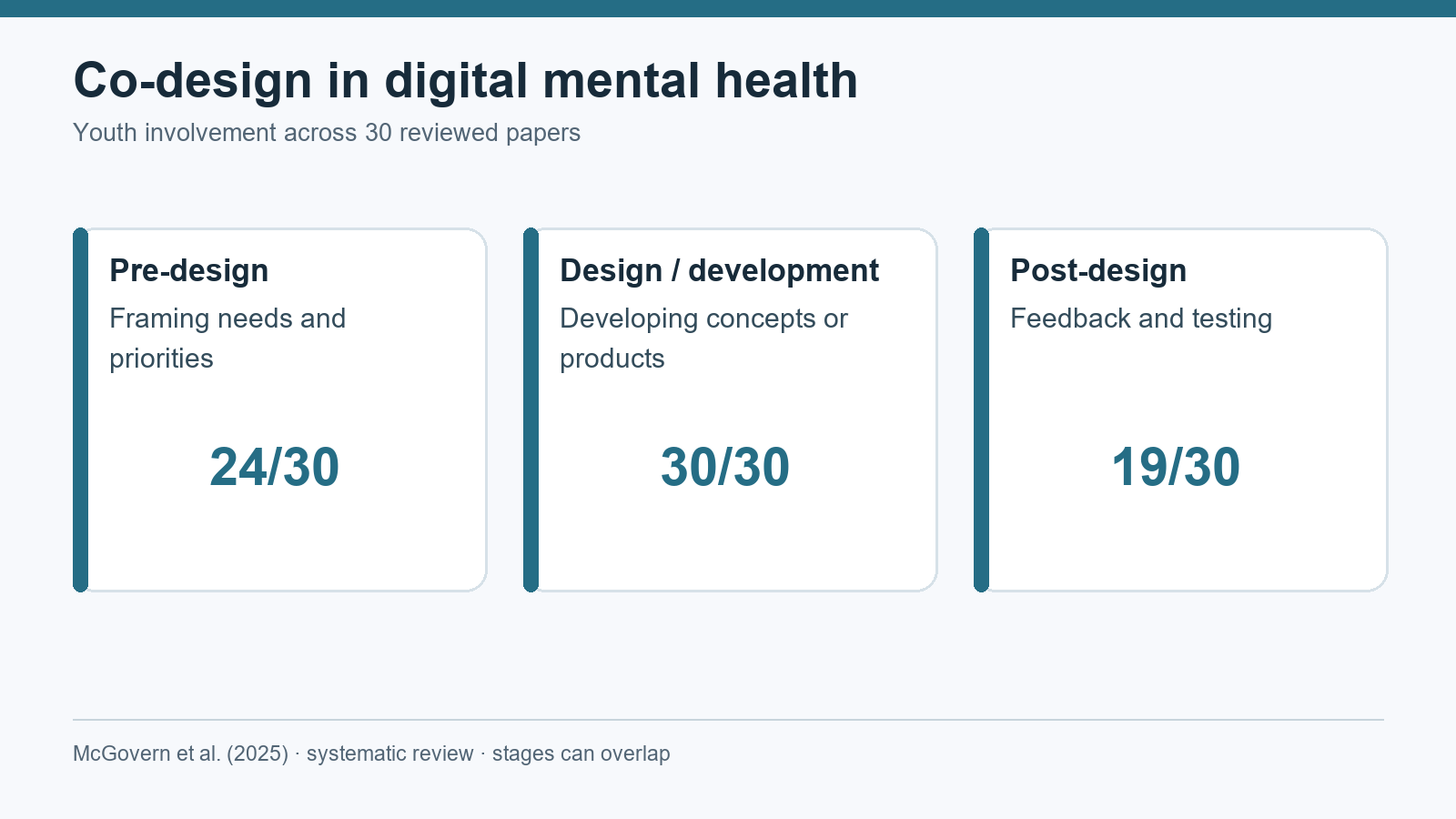
The review considered three stages of digital intervention development:
- Pre-design: 24 of 30 papers included young people in early work.
- Design and development: all 30 involved them at this stage.
- Feedback and testing: 19 reported feedback or testing after development.
What methods were used?
Methods varied across development stages:
- Pre-design: interviews, group discussions, surveys and creative activities such as needs mapping and storyboarding.
- During design: workshops, brainstorming, paper or digital prototyping, and feedback on proposed content and features.
- Feedback and testing: testing mock-ups and gathering feedback on usability and acceptability.
These stages can overlap. The review found that reporting of collaboration quality was much thinner than reporting of activities. Only two papers described how adult–youth power dynamics were handled, and only three evaluated young people’s experience of co-design. Some reported benefits for confidence, skills and agency, but there was little evidence about young people’s decision-making influence. Testing the resulting digital tool was more common than evaluating the experience and quality of involvement itself. No paper met all ten reporting criteria used by the review to assess whether the co-design process was described in sufficient detail.
Improve the process and its reporting
The authors propose attention to four areas: Define the approach and its purpose; Detail what happened; Involve young people meaningfully; and Optimise the process through evaluation and learning. The review does not show that co-design by itself improves clinical outcomes or makes a digital tool effective. It shows what was reported, where practice and terminology vary, and what future projects should describe more clearly.
Reflection: In a report of a youth co-design project, can you tell which decisions young people influenced and how disagreement or power imbalance was managed?
Source: McGovern et al. (2025), “The use of co-design with young people for digital mental health support development”.
4. Co-production Without Youth: Understanding the Participation Gap and Putting Recommendations into Practice
Explore barriers to meaningful involvement in digital youth mental health research and practical recommendations for addressing them. Learn how to support participation across the research lifecycle and establish accountability for how young people’s contributions inform decisions.
Learning Outcome
By the end of this module, learners will be able to:
- Explain conceptual, structural and lifecycle barriers to meaningful youth involvement.
- Identify practical ways to resource and support accessible involvement.
- Plan opportunities for young people to influence decisions across the research lifecycle.
- Describe how to demonstrate accountability through clear responsibilities, feedback, evaluation and transparent reporting.
Why does the participation gap persist?
The previous modules highlighted unclear terminology and limited evidence of young people’s influence. Our opinion piece, Co-production without youth (Blease et al., 2026), examines three drivers of this gap:
- Different disciplinary foundations: HCI, psychological intervention development and PPI draw on distinct traditions with different assumptions about participation and power. Overlapping labels can obscure these differences.
- Lifecycle gaps: involvement often centres on ideas or testing, with fewer opportunities to shape implementation, evaluation and ongoing development.
- Structural barriers: limited funding, fixed timelines, consent requirements and technical constraints make sustained involvement difficult.
Our wider research programme
Our working group has completed an umbrella review of barriers and facilitators to youth participation (Tibbs et al., 2026; protocol available on OSF) in digital mental health research. We have also conducted an international Delphi study with researchers, young people, youth mental health practitioners and organisations. These projects form a wider programme examining how meaningful involvement can be supported across the research lifecycle.
Core recommendations
The opinion piece proposes the following actions:
- Make participation explicit: agree the approach, roles and decisions young people can influence. Explain constraints and revisit expectations as the project develops.
- Resource involvement: budget for fair payment, accessibility, training, facilitation and ongoing support alongside technical development, including resources for partner organisations.
- Design accessible processes: develop understandable materials and training with young people, offering flexible and creative ways to contribute without requiring specialist knowledge.
- Reflect young people’s lives: recognise competing commitments, wellbeing needs and digital fatigue, and agree manageable expectations.
- Sustain influence across the lifecycle: involve young people in problem framing, research design, development, evaluation, dissemination and implementation, with opportunities to shape subsequent updates.
- Build in accountability: identify who is responsible for acting on young people’s contributions. Document and communicate what changed, explain why suggestions could not be adopted, and provide opportunities to question decisions. Evaluate involvement with young people and report its processes, influence and limitations transparently.
These recommendations require planning from the outset. For example, involving young people before the specification of a digital tool is finalised creates opportunities to shape its purpose and features while decisions remain open.
Sources: Blease et al. (2026). Coproduction Without Youth? Closing the Participation Gap in Digital Mental Health Research.
Tibbs et al., (2026). Barriers and Facilitators to PPI in Digital Youth Mental Health Research. An Umbrella Review Protocol.
5. Making Involvement Accountable: The Lundy Model and Practical Checklists
Apply the Lundy model and practical checklists to strengthen meaningful youth involvement and accountability. Learn how to assess opportunities for influence, communicate decisions and report involvement transparently using GRIPP2.
Learning Outcome
By the end of this module, learners will be able to:
- Explain Space, Voice, Audience and Influence.
- Use the Lundy checklist to plan and review youth involvement.
- Establish responsibilities and feedback processes that support accountability.
- Select the appropriate GRIPP2 checklist and distinguish transparent reporting from evidence of meaningful participation.
Putting recommendations into practice
The previous module emphasised accountability for young people’s involvement. The Lundy model and GRIPP2 checklists offer complementary tools: Lundy helps examine whether young people have meaningful opportunities to influence decisions, while GRIPP2 supports transparent reporting of involvement.
The Lundy model: beyond giving young people a voice
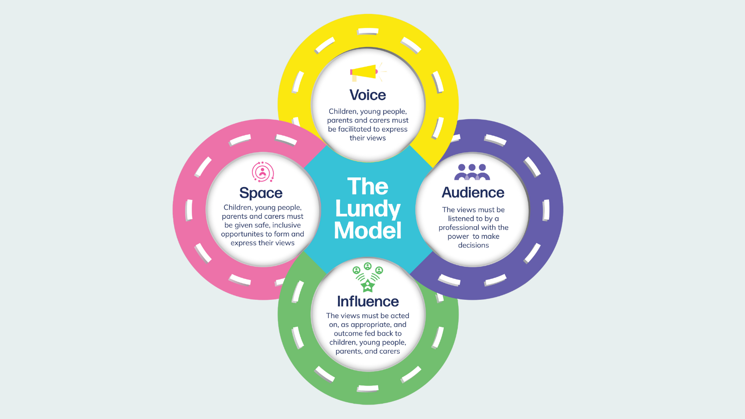
Grounded in children’s participation rights, Lundy’s (2007) model identifies four connected elements:
- Space: provide safe, inclusive opportunities for young people to form and express their views.
- Voice: provide accessible information and support so they can express informed views in ways that suit them.
- Audience: ensure their views reach people with responsibility and authority to consider them.
- Influence: give their views due weight, act where appropriate and explain the resulting decisions.
In digital mental health research, inviting young people to a workshop addresses only part of this process. Researchers also need to consider which decisions remain open, who will respond and how young people will learn what happened.
Using the Lundy checklist
Use the accompanying practical checklist when planning and reviewing involvement across the research lifecycle. Ask:
- Who might be excluded, and what would enable them to contribute?
- Do young people understand the topic, their role and any constraints?
- Who will receive their views and take responsibility for responding?
- How will contributions inform decisions, and how will the response be communicated?
Discuss these questions with young people and revisit them as the project develops. The checklist supports reflection and improvement rather than providing a score that proves meaningful participation.
Accountability in practice
Agree who is responsible for responding to contributions and when feedback will be provided. Keep an accessible record of suggestions, decisions and reasons, including where recommendations could not be adopted. Give young people opportunities to question these explanations.
For example, if young people recommend greater anonymity in an app, researchers should explain how they considered this alongside safeguarding requirements and involve them in exploring workable alternatives.
Reporting involvement with GRIPP2
The GRIPP2 checklists (Staniszewska et al., 2017) help researchers report involvement clearly:
- Short form (GRIPP2-SF): for studies where PPI is a secondary focus. It covers the aims, methods, results, outcomes and critical reflection on involvement.
- Long form (GRIPP2-LF): for studies where PPI is the primary focus, supporting a more detailed account.
Consult the relevant checklist early so that useful information is recorded throughout the project. Report challenges and limitations alongside positive contributions.
Completing GRIPP2 does not establish that involvement was meaningful. Use it alongside the Lundy model and young people’s own assessments of their experiences and influence.
Sources: Lundy (2007). ‘Voice’ is not enough: conceptualising Article 12 of the United Nations Convention on the Rights of the Child.
Staniszewska et al. (2017). GRIPP2 reporting checklists: tools to improve reporting of patient and public involvement in research.
6. Final overview
Bring together the learning path’s themes and translate reflection into practical next steps. Learners connect evidence, participatory approaches, and design perspectives to develop a reasoned approach to inclusive youth engagement and interdisciplinary collaboration.
Learning Outcome
By the end of this module, learners will be able to:
- Synthesize lessons on inclusion, youth engagement, and interdisciplinary innovation across the learning path.
- Justify choices about participation, design methods, and evaluation using the evidence reviewed.
- Formulate next steps for applying the learning while acknowledging evidence gaps and contextual limitations.