Explore the scientific evidence informing contextual and early assessment and intervention in mental health. This learning path brings together research on ambulatory and mobile assessment, personal sensing, machine learning, and prediction in precision psychiatry. Critically examine methodological quality, societal and ethical implications, and barriers to implementation, while distinguishing promising research findings from established clinical utility. Connect insights across the literature to identify evidence gaps and priorities for further investigation.
Learning Outcome
By the end of this learning path, learners will be able to critically synthesize scientific evidence on ambulatory and mobile assessment, personal sensing, and prediction in mental health; evaluate methodological quality, ethical and societal implications, and implementation conditions; and identify evidence gaps relevant to contextual and early assessment and intervention, distinguishing research promise from established clinical utility.
1. Overview
Explore how smartphones can help researchers study mental health in everyday life through digital mood diaries and passively collected behavioral data. The video introduces personal sensing and digital phenotyping, presenting a dynamic view of symptoms and discussing the promise of identifying changes before a crisis.
Consider the video’s concerns about privacy, commercial exploitation, coercive surveillance, and barriers to adoption in mental health services, alongside its emphasis on secure healthcare infrastructure and preserving human care.
Learning Outcome
Summarize the learning path’s main evidence themes and explain how methodological quality, ethical considerations, and implementation conditions shape the interpretation of digital mental health research.
2. Ambulatory assessment for precision psychiatry: Foundations, current developments and future avenues
Explore ambulatory assessment as an approach to studying mental health in everyday contexts. Examine its conceptual foundations, current developments, and future research directions, with attention to data quality, participant burden, and the distinction between research potential and established clinical utility.
Learning Outcome
Explain the foundations of ambulatory assessment and critically evaluate its potential contributions, methodological limitations, and future research needs in precision psychiatry.
Why assess experience in everyday life?
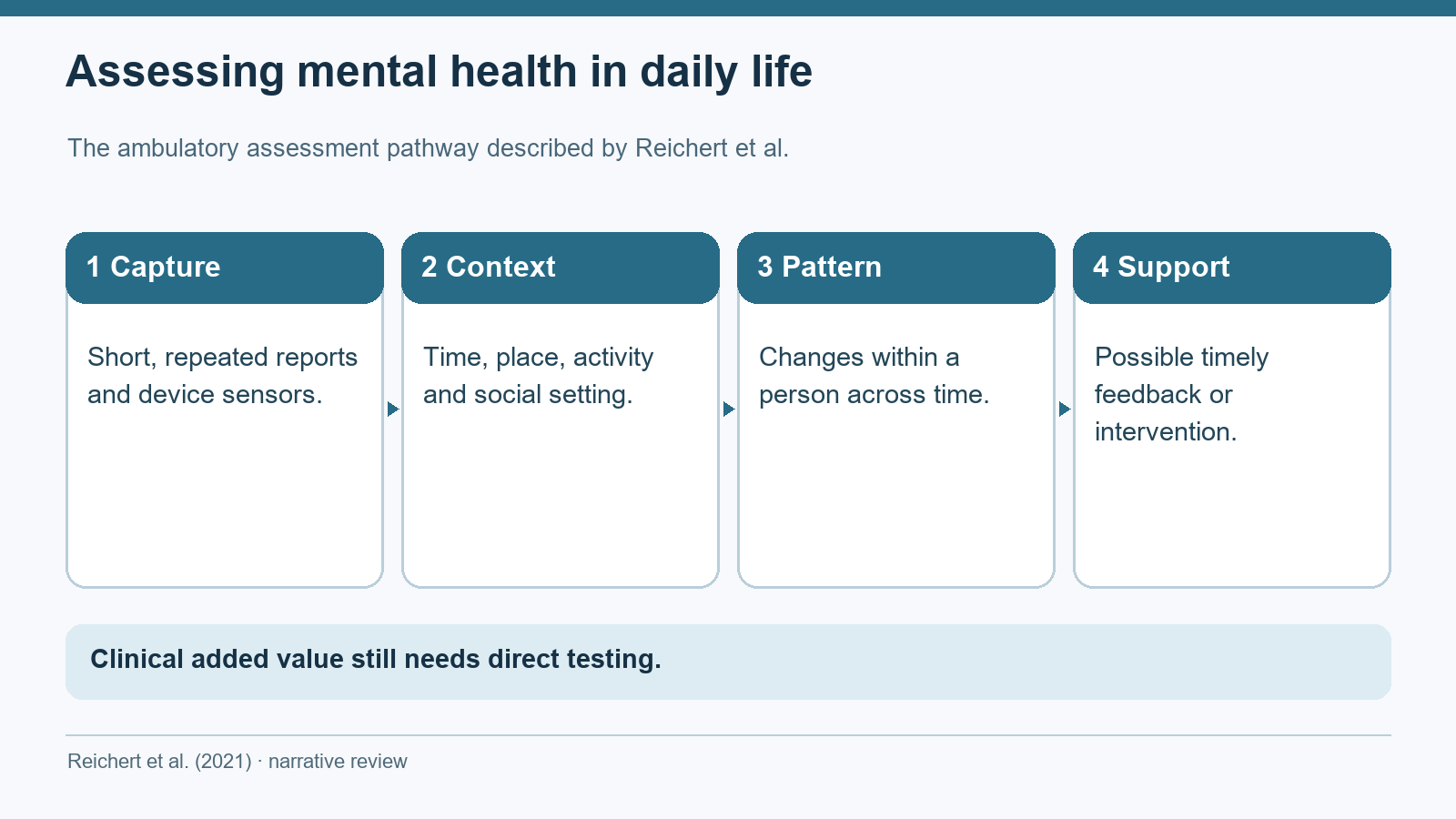
Reichert and colleagues describe ambulatory assessment as repeated measurement outside the clinic. A person may report symptoms or feelings through a diary or smartphone prompt (experience sampling or ecological momentary assessment, EMA). Devices can also record physical activity, location or physiological signals. Combining these observations with time and setting can show how a person’s experiences change across a day. A single retrospective average can hide a rising, falling or fluctuating pattern.
From observation to a useful question
The review argues that precision psychiatry needs both differences between people and changes within the same person. Repeated reports can examine whether a change occurs before or after a context such as a social interaction or activity. Researchers may then study whether this information helps identify a suitable time for support. Ecological momentary interventions and just-in-time adaptive interventions are possibilities discussed by the authors; they are not shown by this review to improve outcomes for every patient.
Design and evidence limits
Choose a sampling schedule that can capture the process of interest: fixed or random prompts, event-triggered prompts, or a combination.
Balance frequent measurement against participant burden, missed entries and the quality of self-report.
Validate sensor-based inferences, because a signal does not automatically reveal a symptom or its cause.
Explain what is collected and protect sensitive data through consent, secure transfer and storage.
The authors call for clinical trials that test whether these methods add value beyond existing assessment and justify their costs.
Reflection: For one research question, identify the momentary experience, the context and the sampling schedule needed to observe change.
Source: Reichert et al. (2021), “Ambulatory assessment for precision psychiatry: Foundations, current developments and future avenues,” attached review.
3. Exploring the societal implications of digital mental health technologies: A critical review
Examine digital mental health technologies through a societal and ethical lens. Consider how data practices, access, commercial interests, and institutional responsibilities may shape their benefits and harms, and explore questions for responsible development and evaluation.
Learning Outcome
Critically appraise the societal implications of digital mental health technologies by examining privacy, equity, autonomy, and accountability in illustrative use cases.
What this review asks
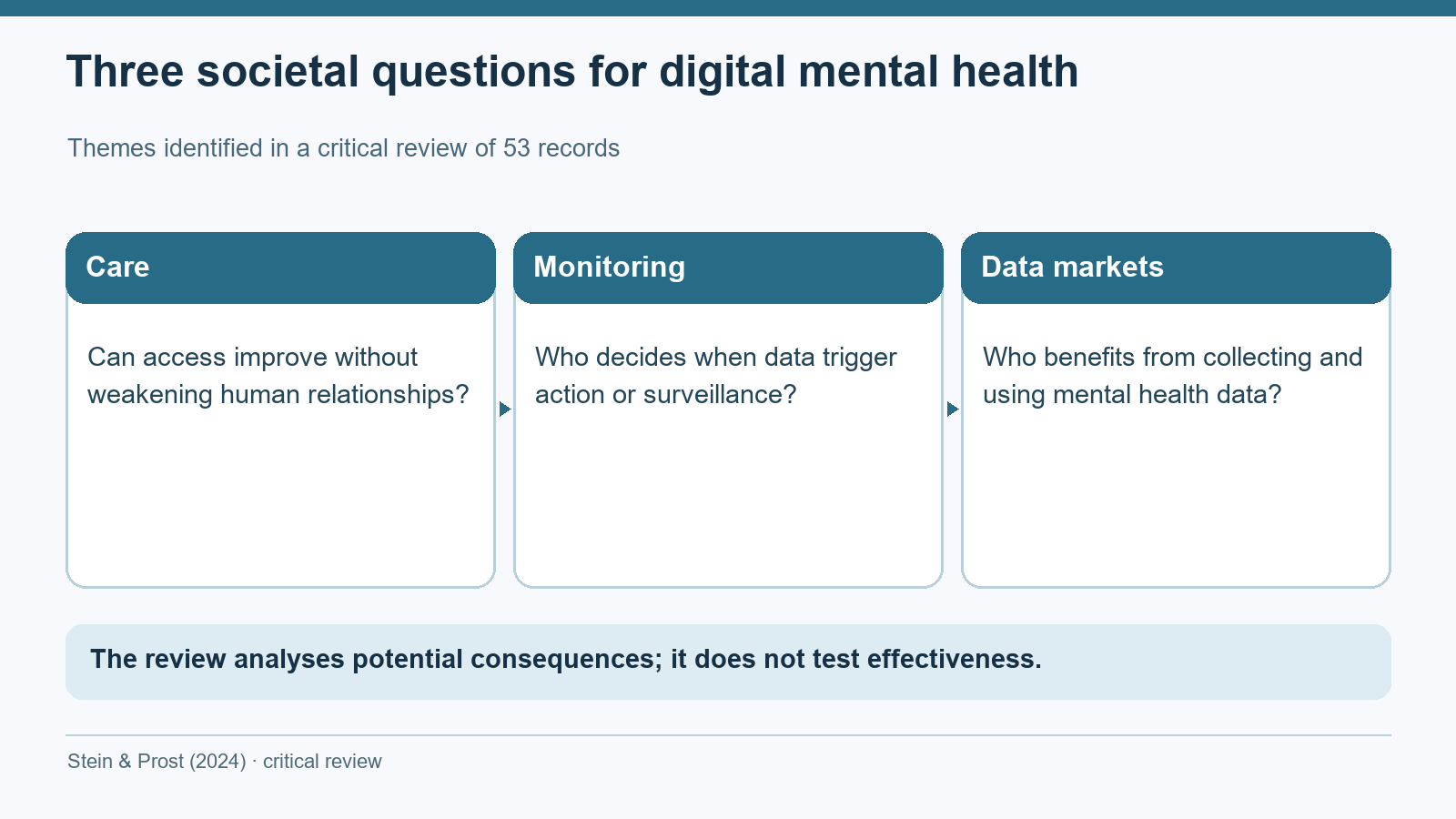
Stein and Prost examined 53 records about digital mental health technologies in a critical review. They focus on social consequences of tools that use large data sets and artificial intelligence, including apps, chatbots, prediction and monitoring systems. Their analysis organizes concerns into three connected areas. It is an analysis of potential effects and published arguments, not a trial showing that a particular product helps or harms users.
Three areas of concern
Mental healthcare: digital services may widen access or support care, especially when linked to clinicians. They may also reduce human contact, shift responsibility onto individuals, or treat ordinary distress as a medical problem.
Monitoring: repeated personal or population data can trigger support, but the same systems can enable surveillance or coercive action. Decisions about consent, agency and who can act on a signal matter.
Commodification: mental health data can become a commercial asset. The review asks who controls the data, who profits, and whether market incentives conflict with care and privacy.
How to read the implications
Benefits and harms depend on the setting, the connection to existing services, and the circumstances of the people using the tool. The authors call for regulation and collaboration with clinicians and communities who experience mental illness. They also note important limits: the synthesis was led by one reviewer, most source material came from high-income Western settings, and empirical data were limited. The review therefore cannot predict every impact in every population.
Reflection: Choose one digital tool and ask how it could affect care, monitoring and data use for a person with limited access to in-person support.
Source: Stein and Prost (2024), “Exploring the societal implications of digital mental health technologies: A critical review,” attached article.
4. The Use of Mobile Assessments for Monitoring Mental Health in Youth: Umbrella Review
Explore the evidence surrounding mobile assessments used to study mental health in young people. Focus on interpreting umbrella-review findings, assessing the quality and limitations of the underlying evidence, and considering age-appropriate consent, privacy, engagement, and participant burden.
Learning Outcome
Critically appraise umbrella-review evidence on mobile mental health assessments in youth, distinguishing feasibility and acceptability from validity and clinical utility.
Two ways to collect information
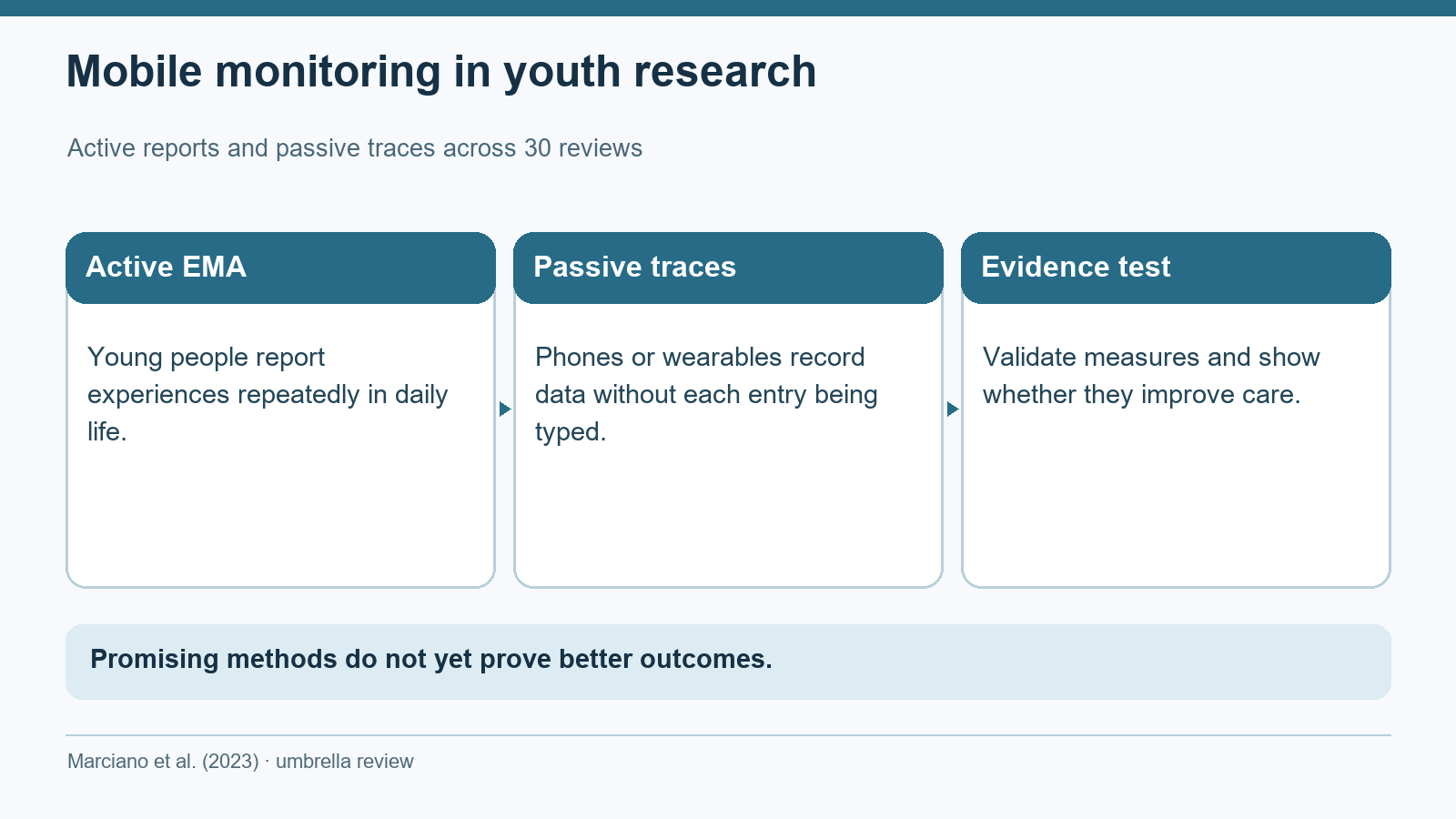
Marciano and colleagues reviewed 30 reviews published from 2016 to 2022 on mobile approaches to young people’s mental health. Ecological momentary assessment (EMA) asks a person to report experiences repeatedly in daily life. Trace data are collected from phone or wearable use without a new self-report at each measurement. The review also discusses ecological momentary interventions, which can provide support at a relevant moment.
What the evidence map shows
Of the 30 included reviews, 21 were systematic and nine were narrative. Among the systematic reviews, six focused on EMA or momentary interventions, seven on trace data, and eight on both. The technologies included smartphones alone, smartphones with wearables, and smartphones with other tools. Much of the literature examined symptoms and ill-being; the authors identify a need to study positive well-being too.
Promise and unresolved questions
Repeated, contextual information might improve awareness of changes over time and complement contact with a clinician. Yet the review does not establish that collecting more data reliably produces better diagnosis or treatment. Studies varied in methods and theoretical grounding, and information about validation was often missing. The authors call for stronger comparisons with existing approaches, clearer standards, and attention to access, digital literacy and underrepresented groups. The included reviews also reported age in inconsistent ways, limiting youth-specific conclusions.
Reflection: If a study measures mood with both prompts and phone traces, what must be checked before a trace is treated as a meaningful mental health indicator?
Source: Marciano et al. (2023), “The Use of Mobile Assessments for Monitoring Mental Health in Youth: Umbrella Review,” attached article.
5. Personal Sensing: Understanding Mental Health Using Ubiquitous Sensors and Machine Learning
Introduce personal sensing as a research approach that uses everyday digital devices and machine learning to investigate patterns associated with mental health. Explore the pathway from sensor data to research inferences, emphasizing uncertainty, potential bias, and the difference between behavioral proxies and clinical conclusions.
Learning Outcome
Describe how ubiquitous sensor data and machine learning are used in personal-sensing research, and evaluate limitations related to measurement validity, generalizability, privacy, and interpretation.
Personal sensing is a chain of inferences
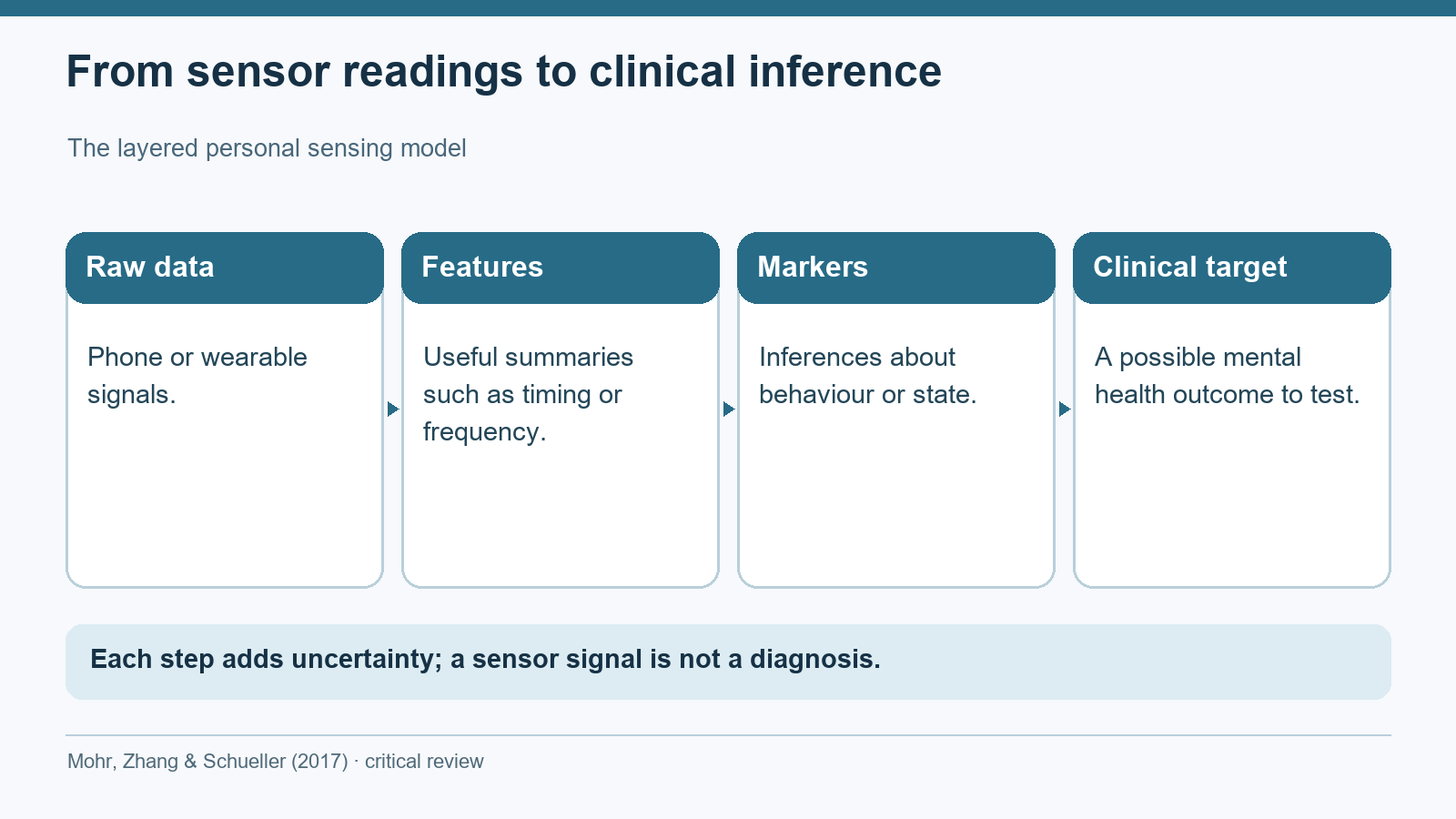
Mohr, Zhang and Schueller describe personal sensing as collecting information from devices used in everyday life, then analysing it to learn about behaviour or mental health. Their model moves through four layers: raw sensor data, features extracted from those data, behavioural markers, and finally a clinical target. For example, phone-use records may be summarized as timing or frequency of activity, then tested as part of an estimate of a sleep pattern. A raw signal, a marker and a clinical conclusion are different things.
Where uncertainty enters
The review describes early studies using phones, wearables, computers and social media. It also warns that results from narrow samples may not reproduce in broader populations. Devices and software differ; people carry and use them differently; and environments change what signals mean. A model can become less accurate as technology or user behaviour changes. Machine-learning validation must avoid designs that overstate prediction accuracy.
Design around people
Passive collection can reduce effort, while occasional active feedback or labels from users may improve a personalized model. The authors discuss the trade-off between burden and accuracy. They also emphasize that every system will make some errors, so the consequences of false positives and false negatives must be considered. Privacy concerns include whether people understand and control use of their data. The review presents a promising research direction, while stating that reliability for routine clinical use had not been demonstrated.
Reflection: Trace one proposed sensor measurement through feature, marker and clinical target. At which step would you ask for independent validation?
Source: Mohr, Zhang and Schueller (2017), “Personal Sensing: Understanding Mental Health Using Ubiquitous Sensors and Machine Learning,” attached review.
6. Precision psychiatry: predicting predictability
Examine what it means for psychiatric outcomes to be predictable and how prediction claims can be assessed. Consider methodological challenges such as overfitting, data leakage, population differences, and validation, while distinguishing research performance from readiness for clinical use.
Learning Outcome
Evaluate claims about prediction in precision psychiatry by distinguishing predictive performance, external validity, and clinical utility, and explaining sources of uncertainty and limits to predictability.
What a prediction model is trying to do
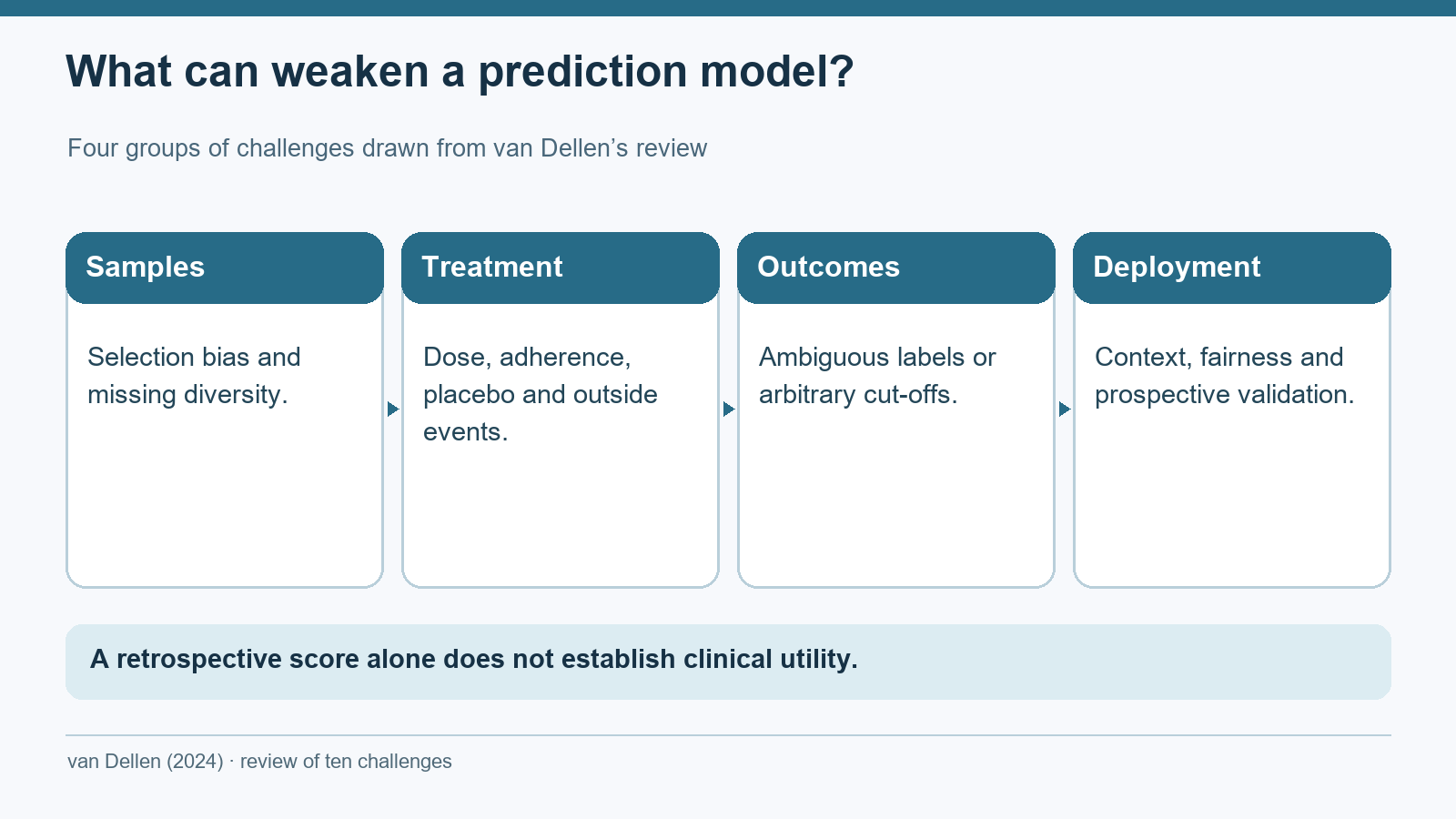
Van Dellen reviews ten challenges for precision psychiatry: using patient information to estimate prognosis or treatment response and help tailor care. A high score on retrospective data is only one step. The model must predict an outcome that matters in practice, for people who resemble those who will use it.
Why apparently accurate results can mislead
Study populations: trial participants may differ from people seen in routine care. Missing groups create questions about generalizability and fairness.
Treatment response: dose, duration and adherence can affect an observed outcome. Placebo effects, natural change and outside stressors may be mistaken for a treatment effect.
Outcome labels: psychiatric diagnoses lack a simple gold standard, and arbitrary thresholds can turn a graded change into a misleading yes-or-no result.
Context and time: static, linear models may miss changing symptoms and environmental influences.
What the author proposes next
The review calls for real-world data, transparent attention to diversity and fairness, prospective validation against current practice, and studies of actual implementation. It proposes combining contextual and dynamic information, including approaches that represent interactions among symptoms. These are directions for research, not proof that any current model should guide an individual clinical decision.
Reflection: Before trusting a treatment-response prediction, ask how the outcome was defined, who was included and whether the model was tested prospectively.
Source: van Dellen (2024), “Precision psychiatry: predicting predictability,” attached review.
7. Barriers and facilitators to the implementation of digital technologies in mental health systems: a qualitative systematic review to inform a policy framework
Explore how individual, organizational, and system-level factors influence the implementation of digital technologies in mental health services. Examine qualitative evidence synthesis and consider how stakeholder perspectives, infrastructure, workforce capacity, governance, and equity can inform policy development.
Learning Outcome
Analyze implementation barriers and facilitators reported in qualitative evidence on digital mental health technologies, and organize them into considerations for a policy framework.
Implementation is a system problem
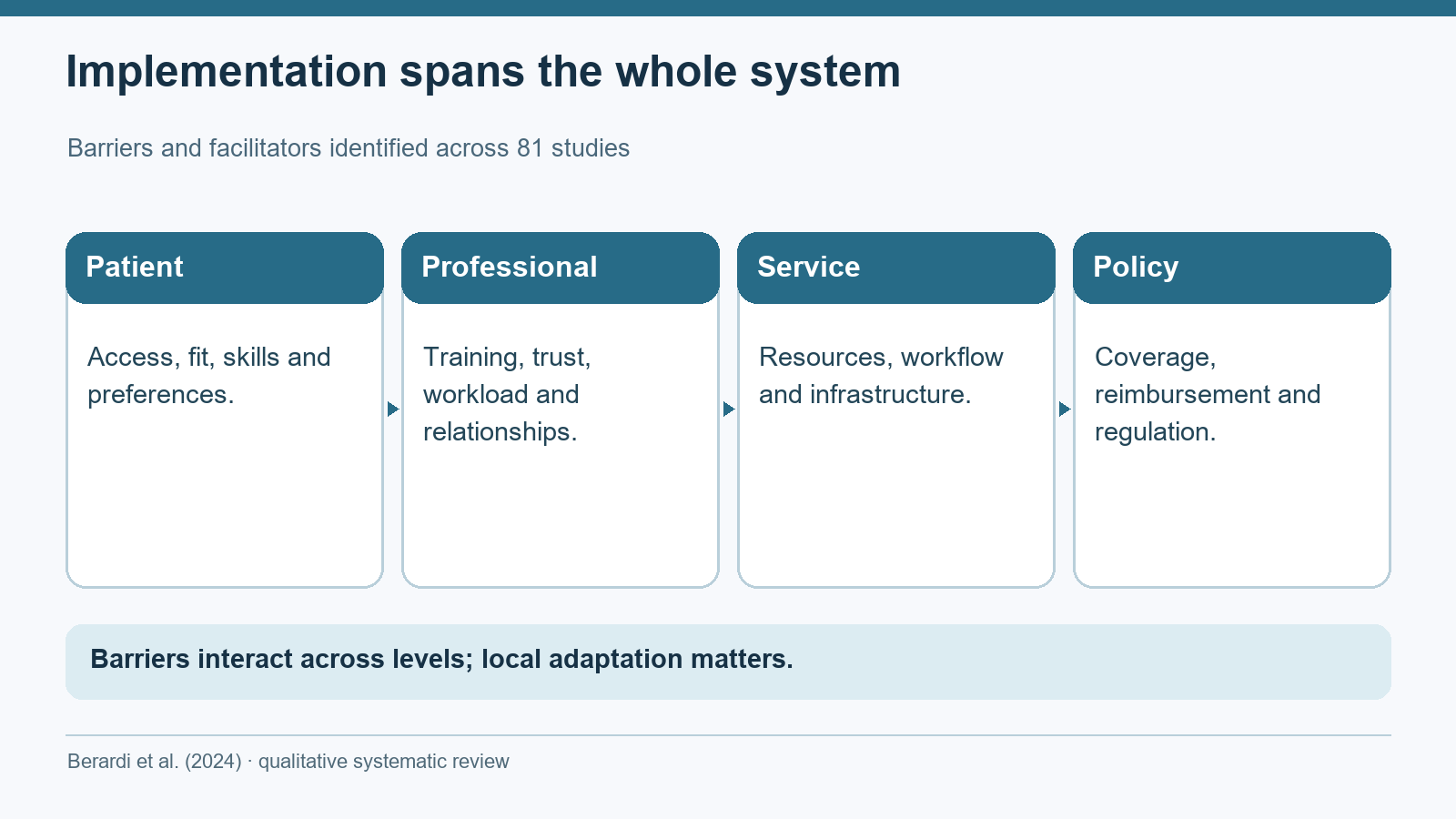
Berardi and colleagues synthesized qualitative findings from 81 studies on digital technology in mental healthcare. Their framework considers four connected levels: patient, professional, organisation or service, and policy. A tool’s usefulness depends on more than its technical features; the people and systems around it affect whether it can be used well.
Barriers and facilitators across levels
Patients: access to devices and data, digital skills, language or cultural fit, and preferences can help or hinder use. Flexibility and trusted guidance can support uptake.
Professionals: inadequate training, extra work or concern about the therapeutic relationship can hinder adoption. Relevant education and collaboration can help.
Services: workflows, staffing, funding and infrastructure determine whether a tool fits routine care.
Policy: coverage, reimbursement and regulation shape who can access digital care and how organisations can sustain it.
What the synthesis supports
The authors recommend person-centred planning, investment in people and resources, and collaboration across organisations and government. Barriers interact: training alone cannot solve lack of connectivity, and a well-designed app cannot by itself solve a reimbursement gap. Most included studies came from high-income countries and the search was limited to English-language peer-reviewed research, so the findings may not capture all settings. This review maps reported implementation experiences; it does not demonstrate that one solution works everywhere.
Reflection: For a proposed digital assessment service, identify one barrier at each level and who would need to address it.
Source: Berardi et al. (2024), “Barriers and facilitators to the implementation of digital technologies in mental health systems,” attached qualitative systematic review.
8. Exploration of the position in the literature
Situate the learning path’s readings within the broader research landscape. Compare their research questions, approaches, and implications to identify connections and tensions across ambulatory assessment, personal sensing, prediction, societal impact, and implementation.
Learning Outcome
Synthesize the learning path’s literature into a thematic evidence map that identifies converging perspectives, methodological differences, and research gaps relevant to contextual and early assessment and intervention.
What the attached document is
The attached “Exploration of the position in the literature” is a WG3 working document. It collects definitions, cited literature, open questions and possible research activities for contextual and early assessment in youth mental health. It is a planning source, not a completed systematic review or a set of established practice standards.
The central conceptual question
The document treats mental health as changing through interactions between a person and their surroundings. It notes that contextual assessment lacks a settled definition in the material reviewed so far. It compares that term with the better-described umbrella of ambulatory assessment, including repeated self-reports, mobile sensing and information about daily contexts. The group still needs to decide how broad its definition should be and whether sensing of the environment belongs within it.
Proposed evidence-building steps
Map youth studies: which data streams were collected, from whom, how often, at what stage of care and with what adherence?
Ask professionals and young people about acceptance, practical barriers and facilitators, using interviews, focus groups or surveys as appropriate.
Compare findings across the literature and the two stakeholder groups; later, consider a structured process to develop a consensus statement.
The document also raises evaluation questions about affordability, language, privacy, prediction error, interpretability and integration into services. These are topics for investigation, not conclusions already established by the document.
Reflection: Choose one unresolved definition or evaluation question and say what evidence would help the group answer it.
Source: Attached WG3 working document, “Exploration of the position in the literature.” This module summarizes that document only.