
Explore scientific evidence on digital tools that support young people’s mental health information-seeking and help-seeking. This learning path brings together future priorities, a cross-country analysis of youth mental health apps in Europe, and review-level evidence on best practices and minimum standards. Learners critically examine tool quality, access, and the implications of information and misinformation, while distinguishing supported findings from evidence gaps.
Learning Outcome
By the end of this learning path, learners will be able to synthesize scientific evidence on digital tools for youth mental health information-seeking and help-seeking; critically appraise tools using evidence-informed best practices and minimum standards; and explain how cross-country differences, information quality, and evidence gaps affect conclusions about accessible, trustworthy digital support.
1. Digital Tools to Support Help-Seeking in Youth Mental Health- Three Priorities for the Future
Explore future directions for digital tools that support young people in seeking mental health information and help. This module focuses on the source’s three priorities and invites learners to consider how they can inform accessible, trustworthy, and youth-responsive digital support.
Learning Outcome
By the end of this module, learners will be able to explain the three future priorities presented in the source for using digital tools to support youth mental health help-seeking and discuss their implications for tool design and implementation.
Why the paper calls for change
“Digital Tools to Support Help-Seeking in Youth Mental Health: Three Priorities for the Future” is a perspective preprint. It brings together an umbrella review, an app-store analysis in seven European countries and co-design workshops with young people and other stakeholders. The authors argue that a first attempt to find help can shape willingness to seek help again. On that view, language, cultural fit and the route to human support matter across a help-seeking journey, not only during one app session.
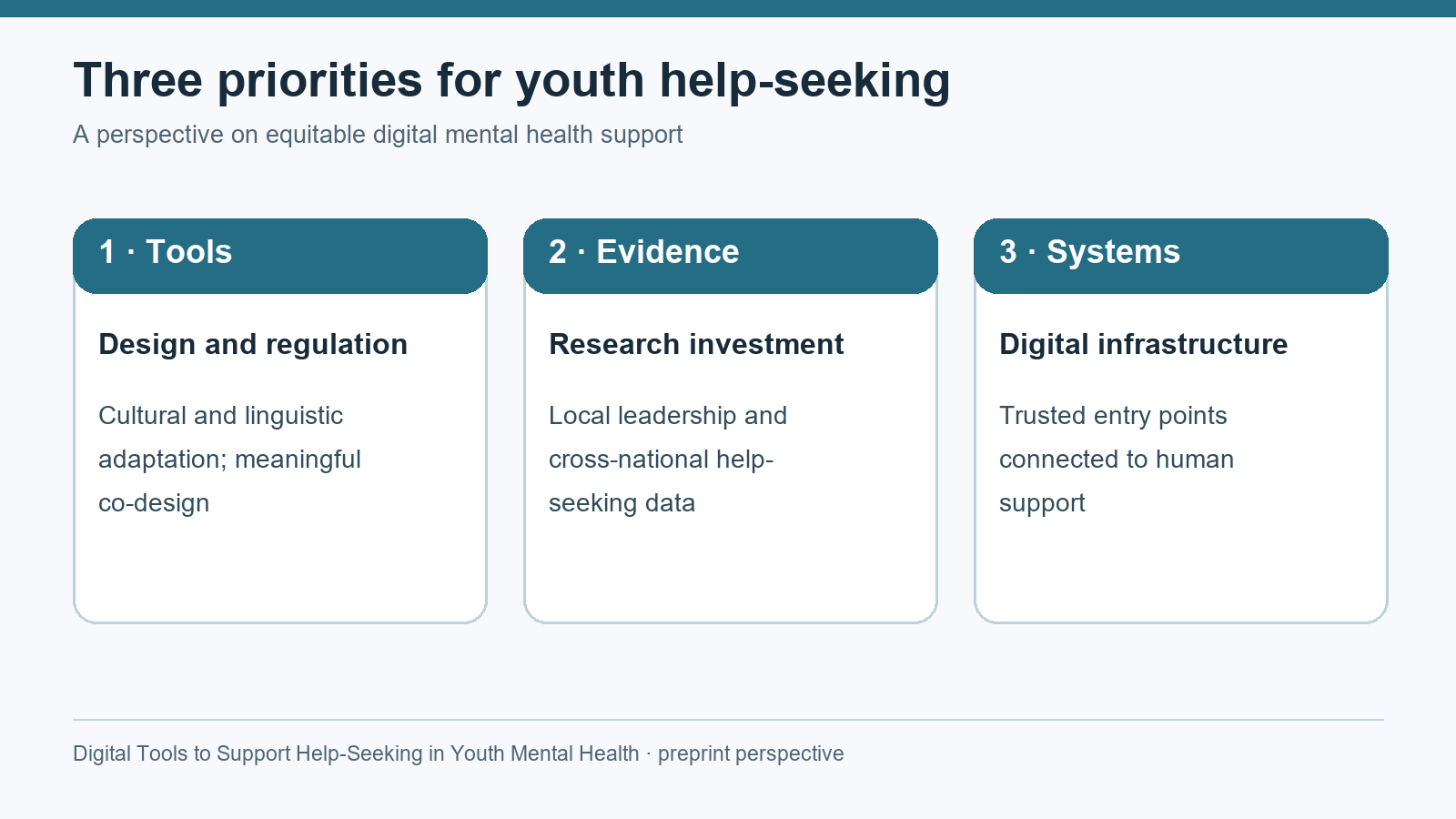
Priority 1: Design and regulation of tools
The paper describes a concentration of research and products in wealthy, English-speaking settings. It argues that making a tool available elsewhere requires more than translation: content, format and delivery need to fit local understandings and help-seeking practices. The authors call for meaningful co-design in underrepresented contexts and for evidence of linguistic and cultural appropriateness when tools are distributed.
Priority 2: Evidence and research investment
Workshop participants raised trust, privacy, stigma, access, personalisation and human connection. They also identified cultural personalisation as an unmet need. The authors recommend funding local research leadership and collecting comparative evidence on the digital routes young people actually follow, including whether experiences affect later willingness to seek help. Workshop perspectives guide the argument; they do not establish how all young people would respond.
Priority 3: System-level infrastructure
Young people and stakeholders in the workshops envisioned a connecting layer across existing services, communities and professional support rather than another standalone app. The paper discusses trusted entry points and possible wider “digital front door” infrastructure, provided there are real services to connect people to. It assigns AI a limited possible role in finding information and navigating options, with locally maintained, human-verified service details. The paper does not test a front-door model or show that an AI tool can replace care.
Reflection: For each proposed priority, ask what evidence would show that a young person can reach relevant human support in their own language and context.
Source: “Digital Tools to Support Help-Seeking in Youth Mental Health: Three Priorities for the Future”.
2. Digital mental health apps for young people in Europe: A systematic cross-country analysis.
Examine a systematic cross-country analysis of digital mental health apps for young people in Europe. Learners explore the study’s scope, approach, and findings, considering how national contexts may shape the availability and accessibility of digital mental health support.
Learning Outcome
By the end of this module, learners will be able to compare findings on youth digital mental health apps across the European countries examined in the source and explain the implications of cross-country similarities and differences for access to digital support.
What the researchers mapped
Madrid Cagigal and colleagues (2026) searched the Apple App Store and Google Play Store between 28 April and 5 May 2025 in Croatia, France, Ireland, Poland, Portugal, Serbia and Türkiye. They used four search concepts: mental health, psychological wellbeing, self-help and stress. Searches used English and local-language terms, except in Ireland, where they searched in English. The seven countries were chosen to illustrate different contexts, not to represent all of Europe.
What appeared in the stores
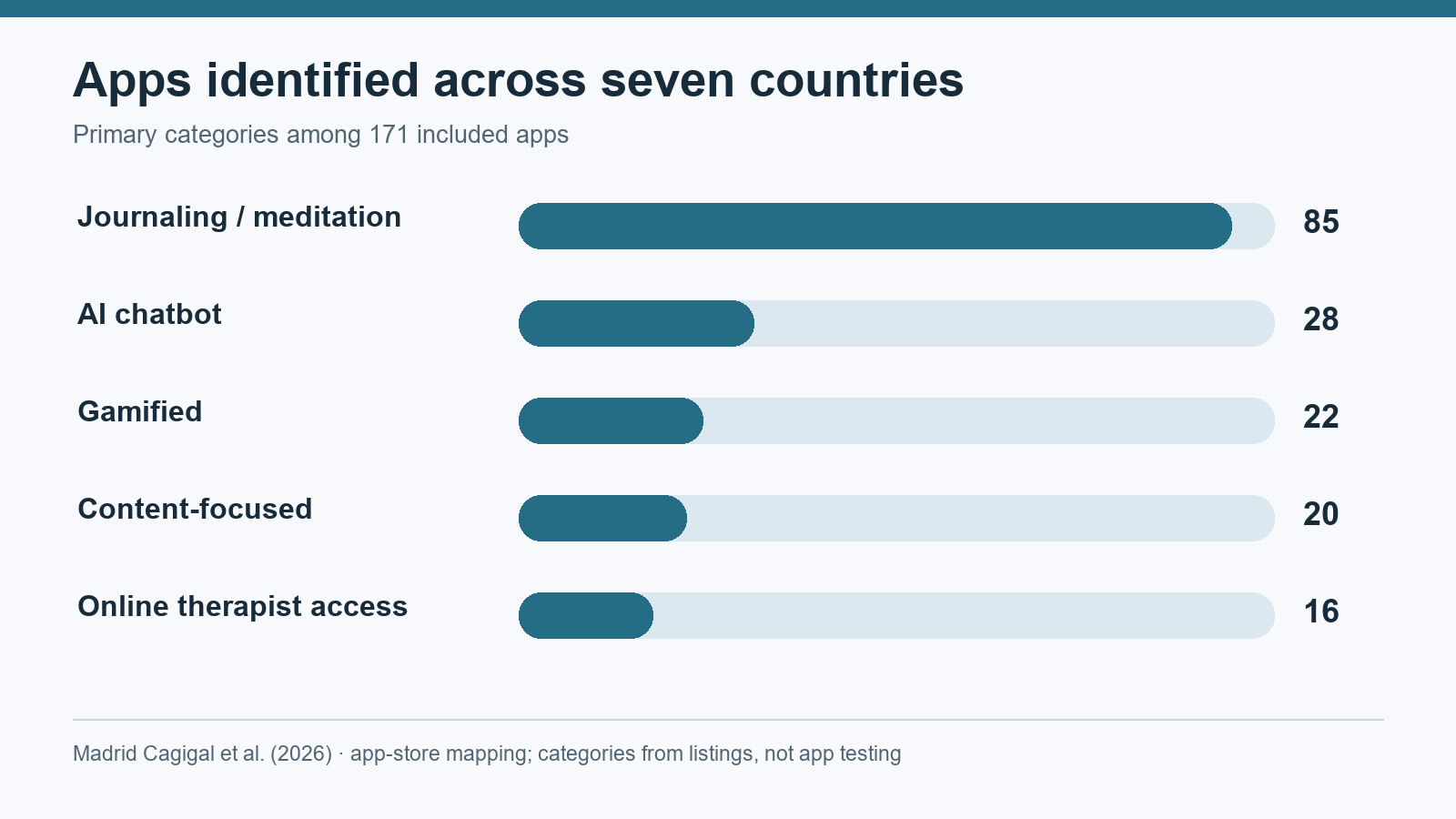
From 967 search results, the team removed duplicates and screened 306 unique apps. They included 171 apps. Using app-store descriptions, they classified 85 as mainly journaling or meditation tools, 28 as AI chatbots, 22 as gamified apps, 20 as content-focused and 16 as offering access to online therapists. These are categories of app listings, not measures of benefit or safety.
Commercial English-language apps appeared prominently across countries. Local-language searches often returned fewer relevant options, especially for some Croatian and Serbian terms, and many results were still English-language apps. The authors found relatively little clear cultural adaptation. Only a small subset of included app descriptions explicitly named young people as the intended audience; a store age rating does not show that an app was designed or tested for youth.
Read the findings within their limits
The study captured only the first ten results per keyword and relied on changing store algorithms and publicly available descriptions. It did not directly test app functions, assess quality or effectiveness, or establish whether an app is developmentally appropriate. Its findings describe visibility and presentation in these seven settings at the search dates.
Reflection: If an app appears prominently in a local-language search, what can its store listing tell you, and what would require direct evaluation?
Source: Madrid Cagigal et al. (2026), “Digital mental health apps for young people in Europe: A systematic cross-country analysis”.
3. Best Practices and Minimum Standards for Promoting Help-Seeking Using Youth Digital Mental Health Tools: An Umbrella Review
Explore review-level evidence on promoting help-seeking through youth digital mental health tools. This module examines the umbrella review’s best practices and minimum standards, supporting critical reflection on tool quality, implementation, and the limitations of the available evidence.
Learning Outcome
By the end of this module, learners will be able to summarize the best practices and minimum standards identified in the umbrella review and use them to critically appraise how a youth digital mental health tool supports help-seeking.
What the umbrella review examined
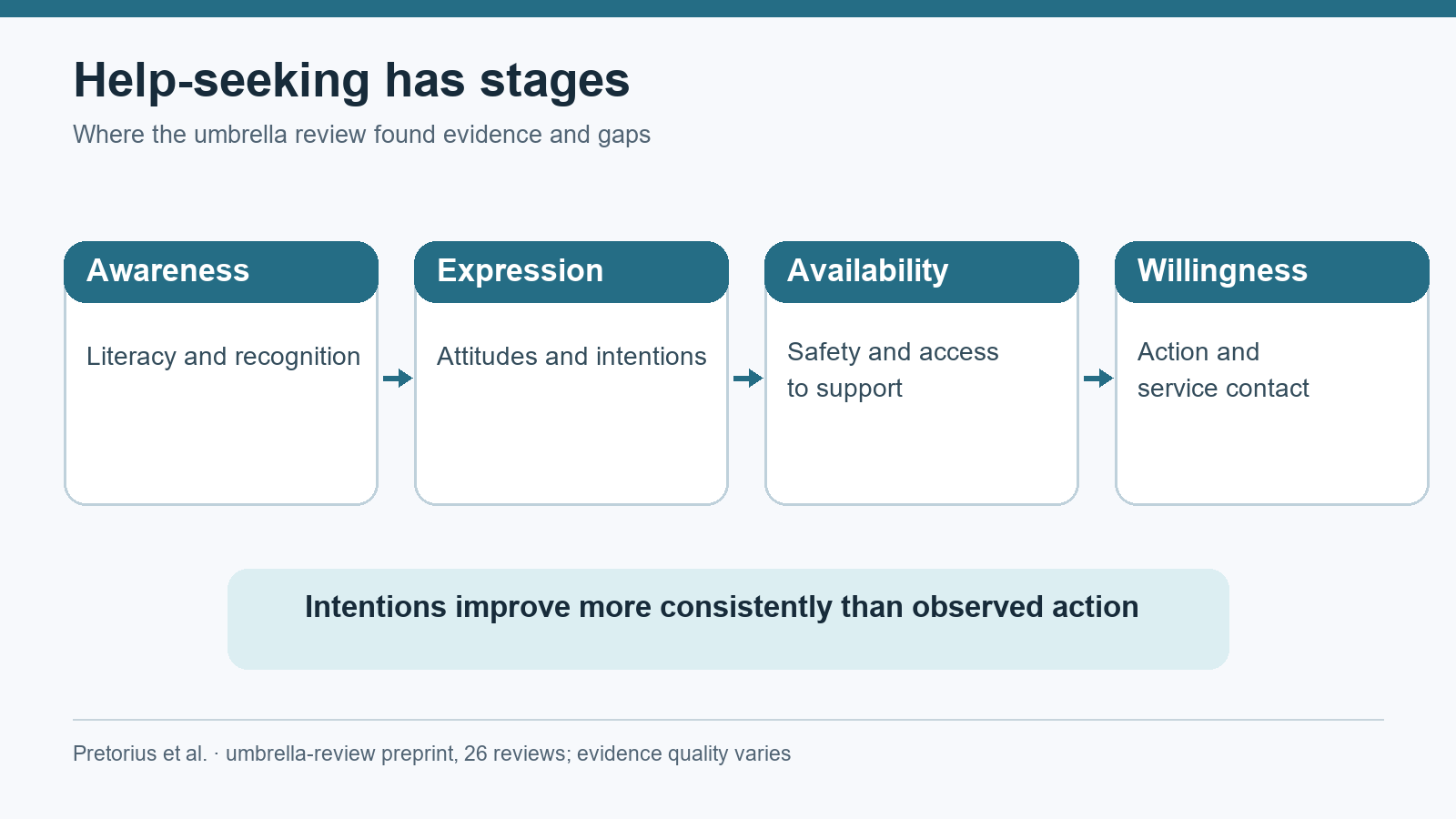
Pretorius and colleagues synthesised 26 reviews of digital mental health tools for young people aged 12–25. Their preprint maps findings onto four stages of help-seeking: awareness of a need, expression of that need, availability of support, and willingness to act. It also considers individual, interpersonal and structural influences. The authors assessed review quality with AMSTAR-2; ratings varied, and many reviews had low or critically low confidence.
The intention–behaviour gap
Across the reviewed literature, tools more often improved mental health literacy, attitudes or intentions than observable help-seeking. Gains at awareness and expression did not reliably become service contact. Evidence of actual behaviour was weaker, inconsistent and often short-term. The clearest behavioural findings came from tools embedded in existing pathways, such as school counselling or primary care, rather than standalone apps. These findings do not establish that every digital tool improves help-seeking.
Practices the authors recommend
Involve young people meaningfully in design, development and evaluation, and report what they changed.
Tailor content and delivery to different users and cultural contexts.
Make the route from digital exploration to human support clear, including referral and handover.
For community-facing and peer-support features, provide professional or clinical moderation, safe messaging and transparent privacy information.
Pair literacy content with skills and pathways to support; distinguish information access from actual help-seeking.
These are the review’s proposed standards, not proof that one feature works in every setting. The authors note overlap among primary studies, limited evidence for several underserved groups, English-language search restrictions and inconsistent measures of behaviour.
Reflection: When evaluating a tool, ask which help-seeking stage it targets and whether its evidence measures intentions or an action toward support.
Source: Pretorius et al., “Best Practices and Minimum Standards for Promoting Help-Seeking Using Youth Digital Mental Health Tools: An Umbrella Review”.
4. Overview of the evidence
Bring together the learning path’s scientific evidence on digital tools, youth mental health help-seeking, and information quality. Learners compare key findings, examine limitations and unanswered questions, and consider how to communicate the evidence without overstating what it shows.
Learning Outcome
By the end of this module, learners will be able to synthesize the evidence presented across the learning path, distinguish supported conclusions from evidence gaps, and explain implications for trustworthy information and youth mental health help-seeking.