
Explore evidence and perspectives on inclusion, meaningful youth engagement, and interdisciplinary innovation in research and digital mental health design. This learning path brings together patient and public involvement, co-design, participatory practice, and user-centered design to examine how people can influence research and development. Critically consider power, participation experiences, contextual barriers, and the limitations of different approaches, then connect these insights to more inclusive collaboration and evaluation in your own work.
Learning Outcome
By the end of this learning path, learners will be able to:
- Critically appraise evidence on inclusion and youth engagement in research and digital mental health design, distinguishing findings from recommendations and evidence gaps.
- Compare patient and public involvement, co-design, participatory design, and user-centered design, and justify their use in a given context.
- Analyze how power, participation burdens, accessibility, and organizational context influence meaningful youth involvement and interdisciplinary collaboration.
- Develop an evidence-informed plan for inclusive youth participation that specifies shared decision-making, participant support, and evaluation of the quality and influence of involvement.
1. Summary of the evidence
An introductory overview of the learning path’s evidence base on inclusion, youth engagement, and interdisciplinary innovation. Learners consider the main messages, reflect on evidence gaps, and connect emerging questions to their own research or design context.
Learning Outcome
By the end of this module, learners will be able to:
- Summarize key messages from the evidence presented on inclusion, youth engagement, and interdisciplinary innovation.
- Distinguish evidence-supported conclusions from areas of uncertainty.
- Identify implications of the evidence for planning inclusive research and design.
2. Evaluating patient and public involvement in health research: from theoretical model to practical workshop
Explore how theoretical approaches to evaluating patient and public involvement can inform practical workshops. The module focuses on planning evaluation collaboratively, gathering meaningful feedback, and considering how involvement shapes research processes and decisions.
Learning Outcome
By the end of this module, learners will be able to:
- Explain the purpose of evaluating patient and public involvement in health research.
- Translate an evaluation model into practical workshop questions and activities.
- Propose criteria for assessing the quality, inclusiveness, and influence of involvement.
How the evaluation workshop worked
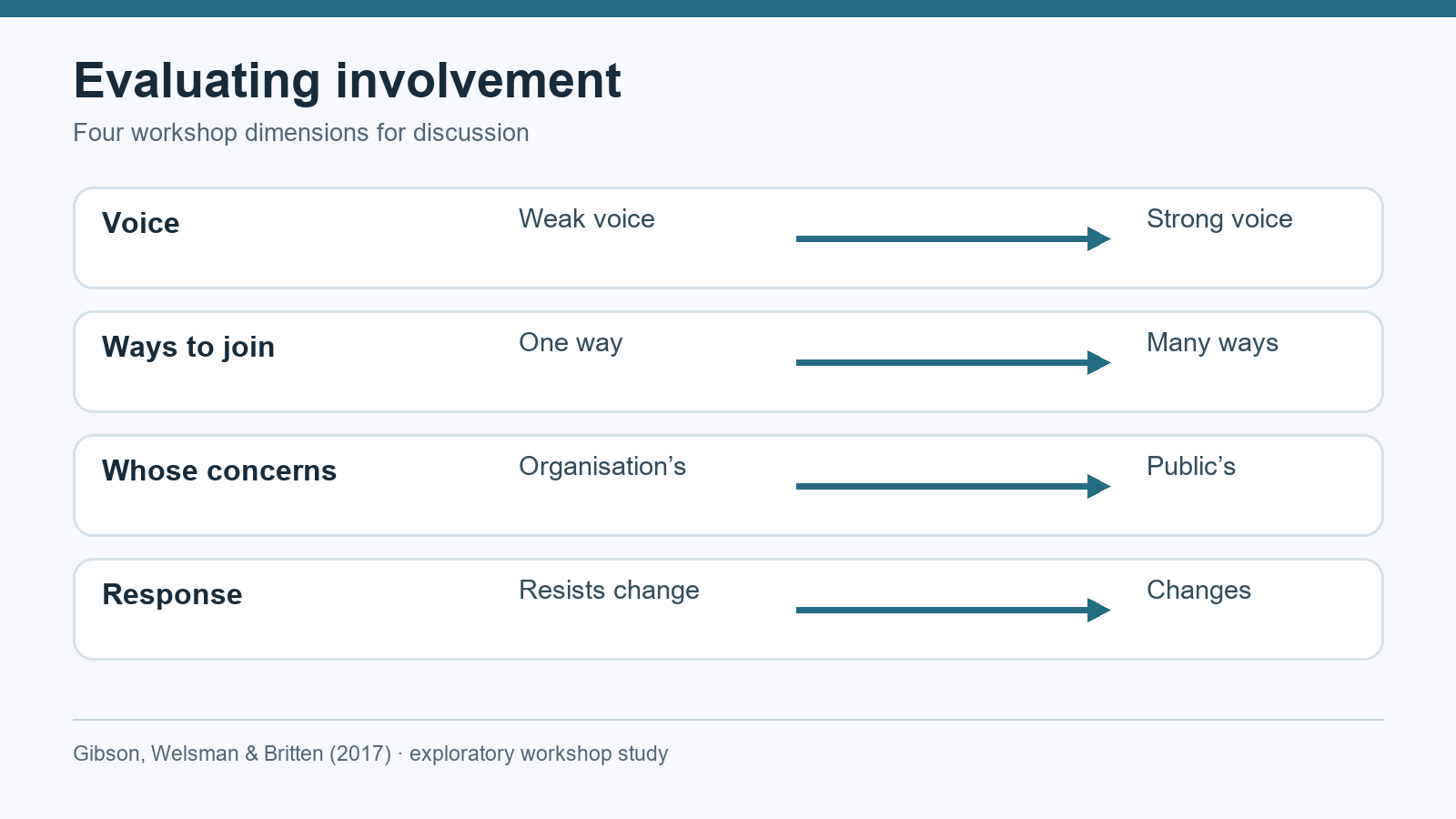
Gibson, Welsman and Britten (2017) turned their theoretical model of patient and public involvement (PPI) into a visual workshop tool. Across three PPI groups, participants mapped their own experiences and then discussed what the maps meant. The four dimensions were expressed in accessible language:
Voice: from weak to strong influence.
Ways to be involved: one route or many routes.
Whose concerns shape the work: the organisation’s concerns or the public’s concerns.
Organisational response: change or resistance to change.
Each workshop lasted about one to three hours. After an introduction, individuals placed notes on visual charts, and the group discussed the resulting patterns. Participants could leave a dimension unanswered. The wording and charts were revised through discussion with participants; the authors removed plus and minus signs because they implied that one end of every dimension was automatically better.
What the maps revealed
Groups described different experiences of influence and access. In one group, the organisation looked more responsive when assessed overall than when participants considered a particular project. Comments around the maps added meaning that a position on a line alone could not show. Some participants were unsure whether the organisation had changed, drawing attention to the need for feedback about what happened after public input.
Use the method carefully
The charts invite discussion; they are not a numerical score or a validated ranking of organisations. The study used small, convenient groups and the workshop required a substantial time commitment. The authors present it as a promising, exploratory way to make the quality of PPI discussable and to identify changes worth considering.
Reflection: If you used these four dimensions with a youth advisory group, what evidence would you ask for before deciding whether the organisation acted on their input?
Source: Gibson, Welsman & Britten (2017), “Evaluating patient and public involvement in health research: from theoretical model to practical workshop”.
3. Understanding Mobile Health and Youth Mental Health: Scoping Review
Examine mobile health in the context of youth mental health through a scoping-review lens. Learners consider how research is mapped, how findings and gaps are interpreted, and what this evidence can contribute to future investigation and inclusive digital design.
Learning Outcome
By the end of this module, learners will be able to:
- Describe the purpose and scope of a scoping review of mobile health and youth mental health.
- Identify themes and evidence gaps reported in the review.
- Explain how review findings can inform research and youth-centered design without establishing clinical effectiveness on their own.
What the review covered
Ding and colleagues (2023) mapped research on mobile health for young people’s mental health published from January 2016 to February 2022. They included 151 studies from 4,270 records. The median participant age across studies was 17 years, and 60 studies were randomised controlled trials. This was a scoping review: it mapped the field and did not critically appraise study quality.
Patterns in the studies
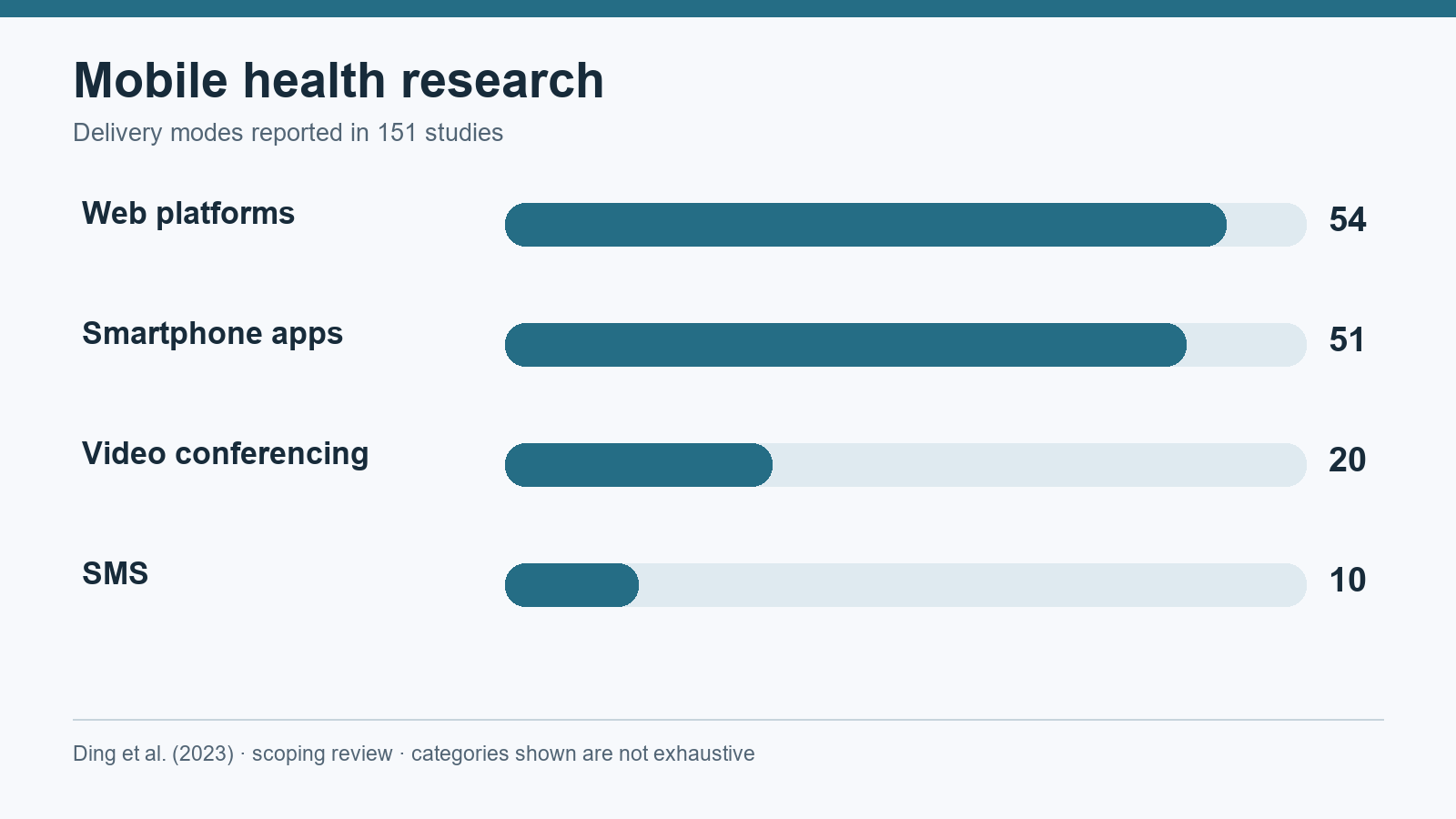
Web platforms appeared in 54 studies (36%); smartphone apps in 51 (34%); video conferencing in 20 (13%); and SMS in 10 (7%).
Depression and anxiety were common targets. The review identified less work on self-harm, violence and substance use.
143 of 151 studies (95%) took place in developed countries. Only three (2%) reported a sex or gender category beyond the binary; 20 did not report sex or gender.
Young people were usually engaged as testers or sources of feedback, with less involvement in initial design.
How to interpret the evidence
The authors classified 123 of 151 papers (81%) as reporting positive outcomes, but the interventions, measures, study designs and follow-up periods varied. That count does not establish that mobile mental health interventions are effective as a class. The authors highlight gaps in youth-centred measures, implementation and scaling frameworks, and inclusion of young people across settings and identities. They call for greater youth involvement early in development and for more attention to equity and longer-term implementation.
Reflection: When reading a study of a new mental health app, check who shaped its design, who was represented in testing, what outcome was measured, and how long follow-up lasted.
Source: Ding et al. (2023), “Understanding Mobile Health and Youth Mental Health: Scoping Review”.
4. Participation User Experience: A Call to Better Manage the Most Important Resource in User-Centered Design
Consider participation itself as an experience that requires thoughtful design. This module explores how user-centered projects can respect contributors’ time, reduce barriers and burdens, and support meaningful relationships throughout the design process.
Learning Outcome
By the end of this module, learners will be able to:
- Explain why participants’ experiences matter in user-centered design.
- Identify potential participation burdens and barriers across a design project.
- Propose ways to support respectful communication, meaningful contribution, and feedback to participants.
Participation is an experience
Heinisch and colleagues (2025) argue that user-centred design (UCD) should pay more attention to the experience of people who participate in studies, which they call participation user experience (PUX). It begins before a session, continues during participation and extends to what happens afterward. Their account draws on a workshop with 20 experienced UCD practitioners and researchers; it is an exploratory contribution, not a tested causal model.
Five themes from the workshop
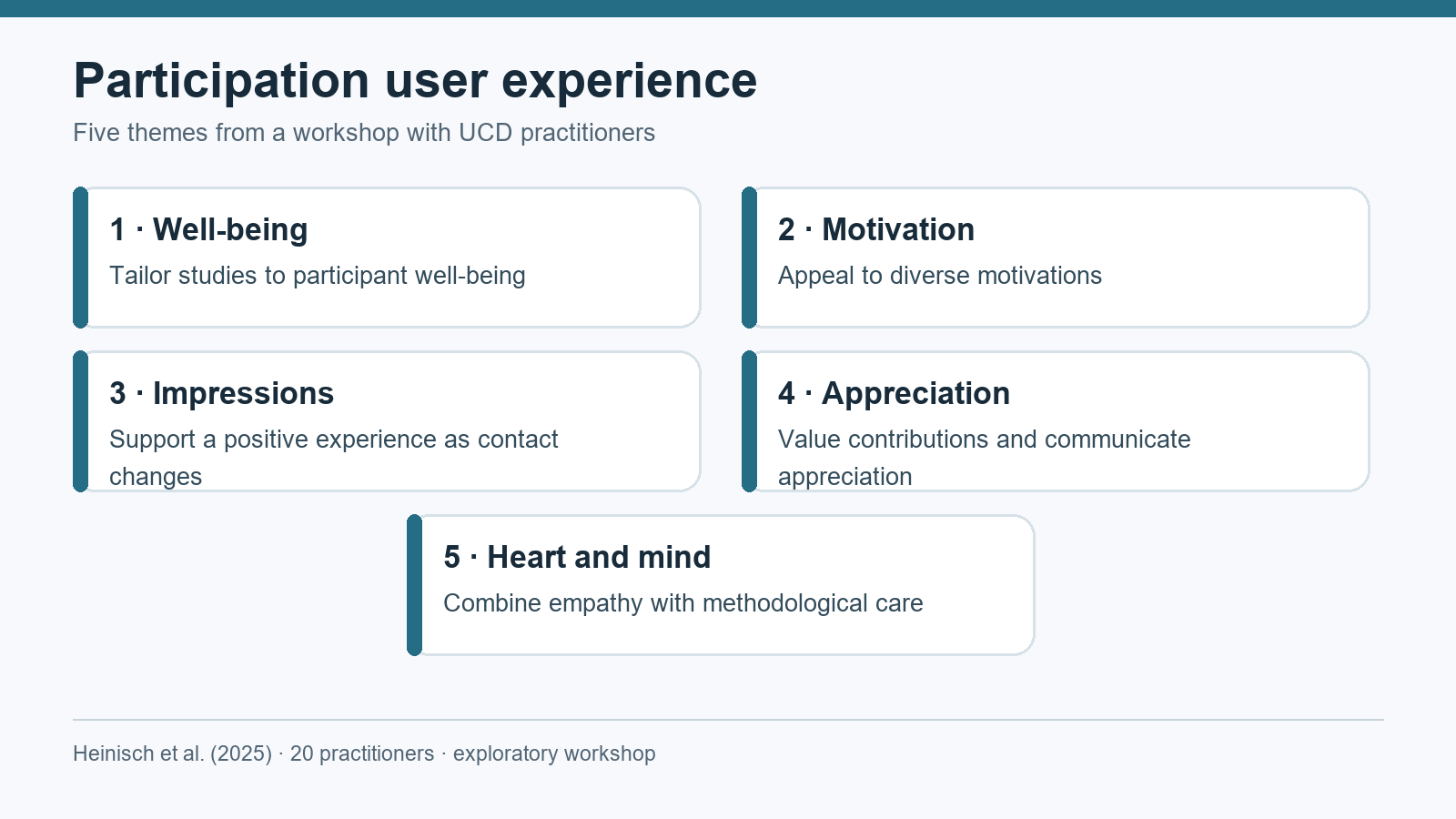
Protect well-being: adapt study demands, timing, breaks and accessibility to participants.
Recognise different motivations: people may value compensation, learning, contribution or other reasons to join.
Manage changing contact: first impressions and later communication both shape the experience.
Show appreciation: acknowledge contributions and explain what happened with the input.
Use heart and mind: combine empathy with sound research practice.
Clear instructions, transparent purposes, respectful facilitation and appropriate compensation are practical considerations the authors discuss. They also warn that making a session pleasant can affect the evidence collected: social desirability, experimenter effects or a halo effect may influence feedback.
What this paper can and cannot establish
The themes came from professionals’ workshop statements rather than direct research with participants about their experience. The brief format limits depth. The paper offers a call and a starting framework for future study; it does not show that any one PUX practice improves study outcomes.
Reflection: In a youth design session, how would you make participation respectful while still inviting honest criticism?
Source: Heinisch et al. (2025), “Participation User Experience: A Call to Better Manage the Most Important Resource in User-Centered Design”.
5. For more on young people’s health and wellbeing
Read a 2025 editorial on local context, adult–youth power and meaningful youth leadership in mental health work. Consider its examples and the limits of an editorial as evidence.
Learning Outcome
By the end of this module, learners can explain the editorial’s argument about local context and power, identify where youth can share decisions and resources, and distinguish an editorial recommendation from evidence of intervention effectiveness.
Recognising context and power
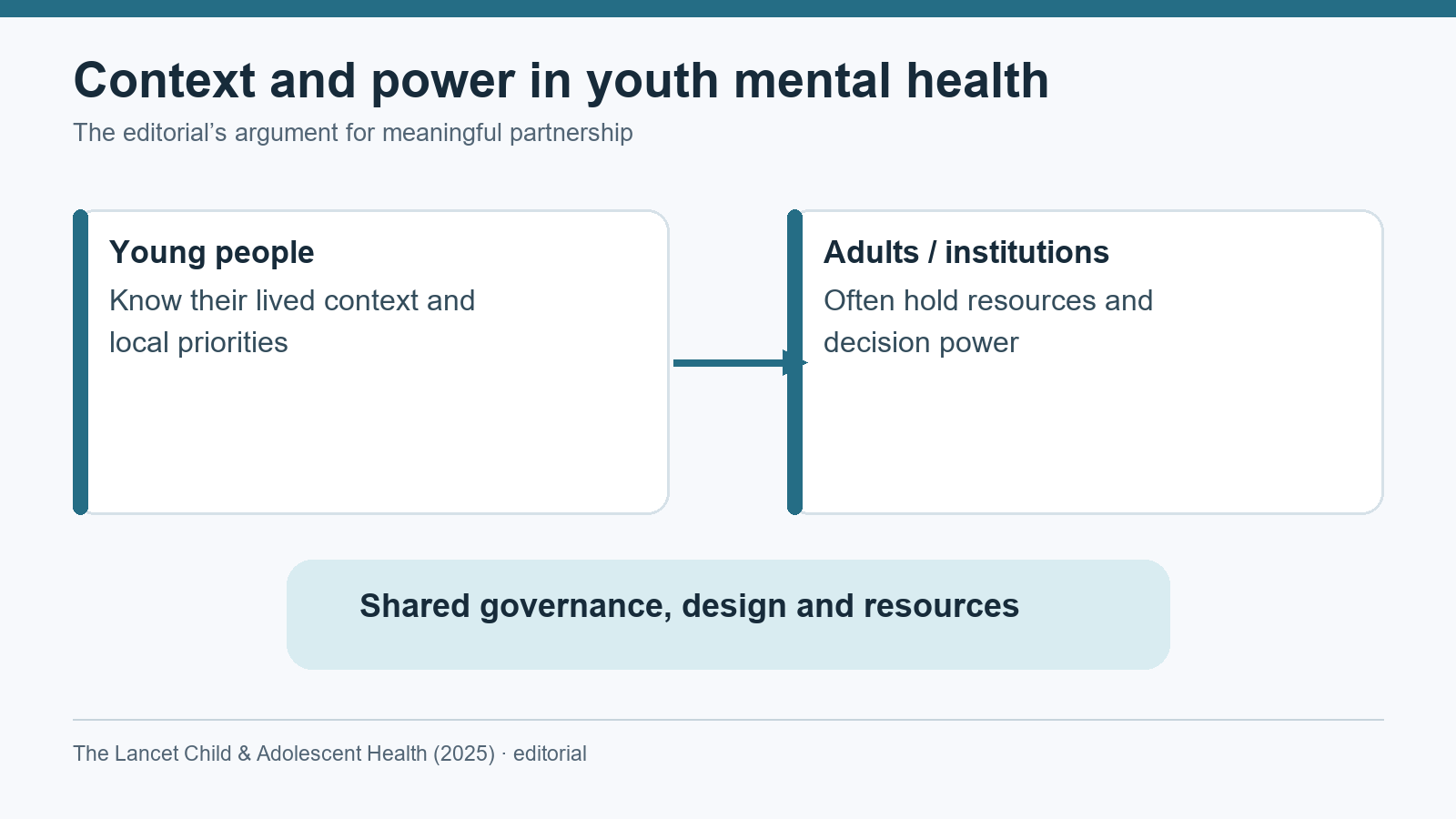
A 2025 editorial in The Lancet Child & Adolescent Health argues that youth mental health work must take young people’s local circumstances and their share of decision-making power seriously. Young people know the settings in which they live; adults and institutions often control research agendas, funding and services. The editorial calls for more equal partnership rather than superficial consultation.
Why local context matters
The editorial gives examples of priorities that differ by place: family functioning in Colombia and India, performance-driven education in Morocco, bullying in Ghana, Indonesia and Romania, and substance use in Sierra Leone. These examples illustrate why priorities should be identified with local young people. They are not evidence that one approach works everywhere.
From consultation to leadership
The authors point to locally informed peer-support initiatives, including the Shamiri Institute in Kenya and youth peer support workers in Europe. They do not compare these programmes or establish which is most effective. Their central recommendation is to involve young people in governance, conception, design and implementation, with real responsibility and resources. That requires adults to share decisions as well as ask for opinions.
This is an editorial argument, not an intervention trial. It can guide questions about power and relevance, but it cannot by itself show that co-design or peer support improves mental health outcomes.
Reflection: In a project you know, who sets the priorities, who controls resources, and at which decisions can local young people change the direction?
Source: “Recognising context and power in youth mental health,” The Lancet Child & Adolescent Health (2025).
6. The use of co-design with young people for digital mental health support development
Explore co-design as an approach to involving young people in the development of digital mental health support. The module emphasizes meaningful influence, accessible participation, and ethical considerations, while distinguishing collaborative design from evidence of clinical effectiveness.
Learning Outcome
By the end of this module, learners can identify when young people were involved across the reviewed studies, explain the reporting gaps around power and participant experience, and distinguish a review of co-design practice from evidence of clinical effectiveness.
What the systematic review found
McGovern and colleagues (2025) reviewed 30 empirical papers on co-design with young people aged up to 25 for digital mental health support. Across those papers, 1,180 young people participated, with individual study samples ranging from four to 131. The papers used terms such as co-design, co-production and participatory design inconsistently, making approaches difficult to compare.
When were young people involved?
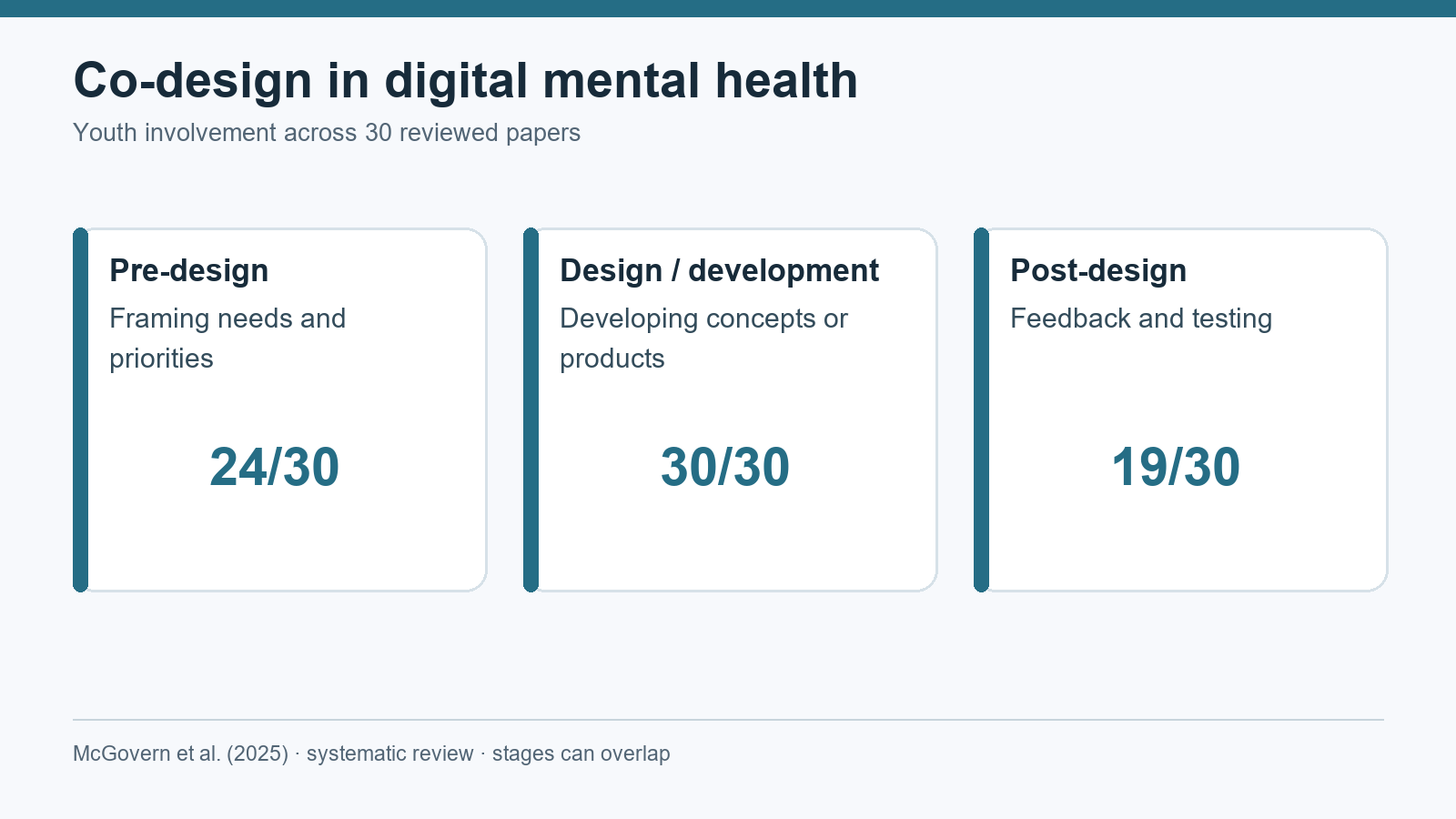
Before design: 24 of 30 papers included young people in early work.
Design and development: all 30 involved them at this stage.
After design: 19 reported feedback or testing after development.
These stages can overlap. The review found that reporting of collaboration quality was much thinner than reporting of activities. Only two papers described how adult–youth power dynamics were handled, and only three evaluated young people’s experience of co-design. No paper met all ten of the review’s reporting criteria.
Improve the process and its reporting
The authors propose attention to four areas: Define the approach and its purpose; Detail what happened; Involve young people meaningfully; and Optimise the process through evaluation and learning. The review does not show that co-design by itself improves clinical outcomes or makes a digital tool effective. It shows what was reported, where practice and terminology vary, and what future projects should describe more clearly.
Reflection: In a report of a youth co-design project, can you tell which decisions young people influenced and how disagreement or power imbalance was managed?
Source: McGovern et al. (2025), “The use of co-design with young people for digital mental health support development”.
7. Extended User Centered Design (UCD) Process in the Aspect of Human Computer Interaction
Examine an extended user-centered design process within human-computer interaction. Learners connect contextual inquiry, requirements, design, and evaluation, considering how iterative feedback can strengthen the fit between an interactive system and the people who use it.
Learning Outcome
By the end of this module, learners will be able to:
- Outline an iterative user-centered design process in human-computer interaction.
- Explain how understanding users, tasks, and contexts informs requirements and design evaluation.
- Map an extended user-centered design process to a sample project and identify opportunities for user feedback.
A proposed extension to UCD
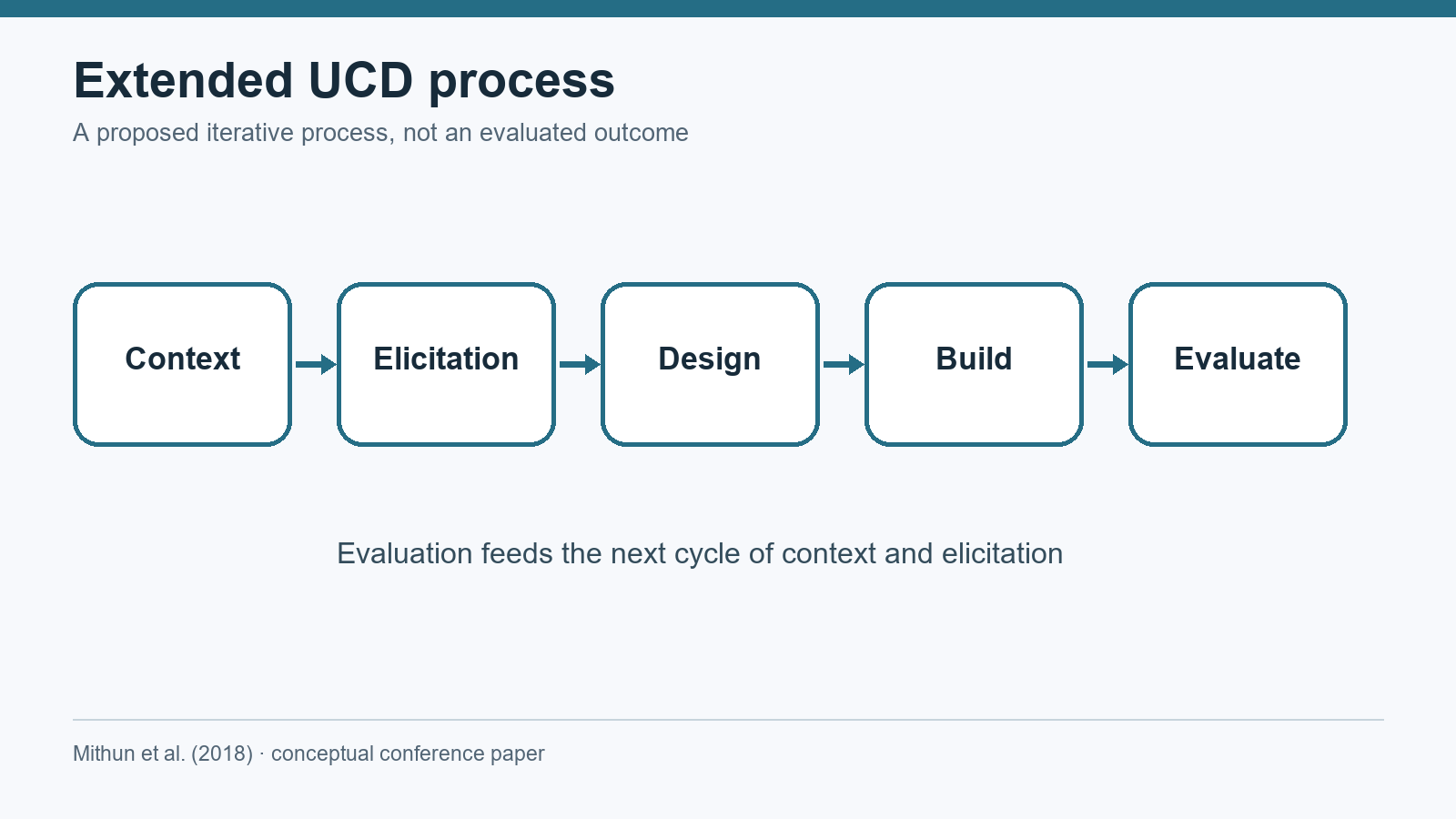
Mithun and colleagues (2018) propose an extended user-centred design (UCD) process for human–computer interaction. Their paper is a conceptual proposal, not an evaluation showing that the process reduces failures or improves outcomes. The proposed cycle has five stages: Context → Elicitation → Design → Build → Evaluate. Evaluation can feed the next iteration rather than end the work.
Why make elicitation explicit?
The authors distinguish initial understanding of a project’s context from gathering detailed requirements. In their model, elicitation seeks input from users, customers and other stakeholders before design decisions harden. The paper mentions observation, interviews, workshops, brainstorming, use cases and prototyping as ways to discover needs and requirements. The resulting understanding informs design and construction, which are then evaluated.
The paper does not test the proposed process in a youth mental health setting or another intervention study. Its stages should be treated as a framework to examine rather than established evidence of impact.
Evidence limit
The article describes the framework and argues why the added stages may be useful. The authors leave evaluation of the framework for future work. Claims about improved usability, effectiveness or lower failure rates therefore remain expectations, not findings established by this paper.
Reflection: What would you need to observe or measure to test whether a distinct elicitation stage actually changes a project’s design decisions?
Source: Mithun et al. (2018), “Extended User Centered Design (UCD) Process in the Aspect of Human Computer Interaction”.
8. Participatory Design in Human-Computer Interaction: Cases, Characteristics, and Lessons
Explore participatory design through cases, defining characteristics, and practical lessons in human-computer interaction. Learners examine the roles of participants and designers, consider how influence is shared, and reflect on how context shapes participatory practice.
Learning Outcome
By the end of this module, learners will be able to:
- Describe defining characteristics of participatory design in human-computer interaction.
- Compare how participation and decision-making are organized across the cases presented.
- Apply lessons from the cases to justify a participatory approach for a new design scenario.
What the case review examined
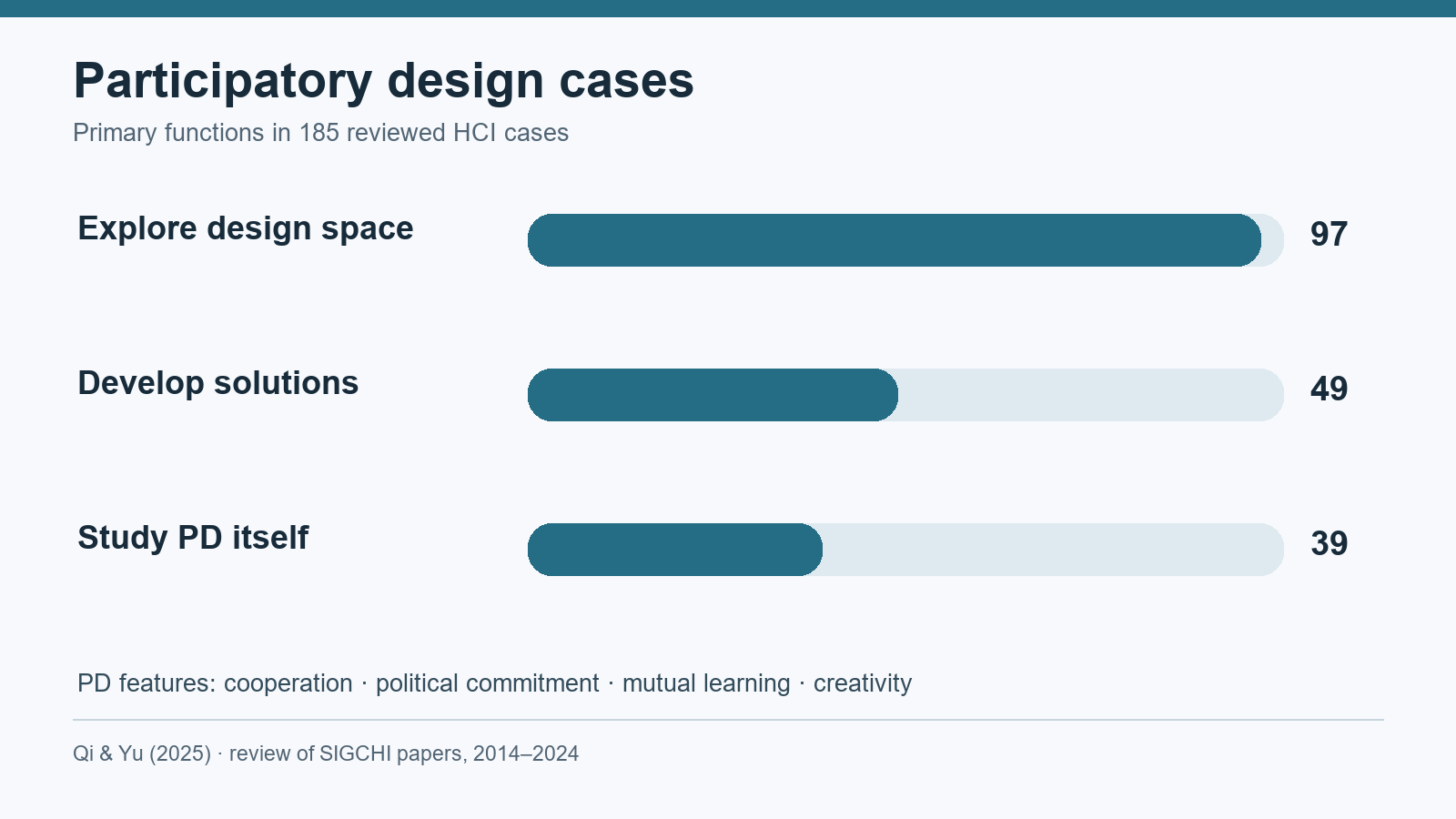
Qi and Yu (2025) reviewed 185 participatory design (PD) cases reported in SIGCHI papers from 2014 to 2024. They grouped cases by their main function: 97 explored a design space (52.43%), 49 developed solutions (26.49%), and 39 studied PD itself (21.08%). These categories describe the review’s coding of published cases; a project can serve more than one purpose.
What makes design participatory?
The authors use four core features to examine the cases: cooperation, political commitment, mutual learning and creativity. Political commitment includes democracy and empowerment: people affected by design should have a meaningful chance to influence decisions. Merely asking them to test a finished concept or supply information does not fully meet that ambition. The authors also caution against treating a single workshop or an ideation stage as the whole of PD.
From participation to influence
Only 11 of the 185 cases were identified as producing tangible empowerment in real-world settings; many cases remained at the ideation stage. The paper therefore asks readers to look beyond whether a participatory activity occurred and ask what authority and lasting effects participants gained.
The review depends on what papers reported. The case sample is weighted toward Western settings, and the authors’ own PD perspective shapes the analysis. Its counts should not be taken as a universal map of all participatory design practice.
Reflection: In a reported PD project, what evidence shows that participants could change a consequential decision rather than only contribute ideas?
Source: Qi & Yu (2025), “Participatory Design in Human-Computer Interaction: Cases, Characteristics, and Lessons”.
9. The Limitations of User-and Human-Centered Design in an eHealth Context and How to Move Beyond Them
Critically examine the limits of user- and human-centered design when applied to eHealth. The module encourages learners to look beyond individual interactions, consider organizational and wider-system influences, and explore ways to broaden their design approach.
Learning Outcome
By the end of this module, learners will be able to:
- Identify limitations of user- and human-centered design in eHealth contexts.
- Analyze how organizational conditions, stakeholder relationships, and wider systems can affect design outcomes.
- Propose complementary perspectives or methods and justify how they address an identified limitation.
A viewpoint on the limits of HCD
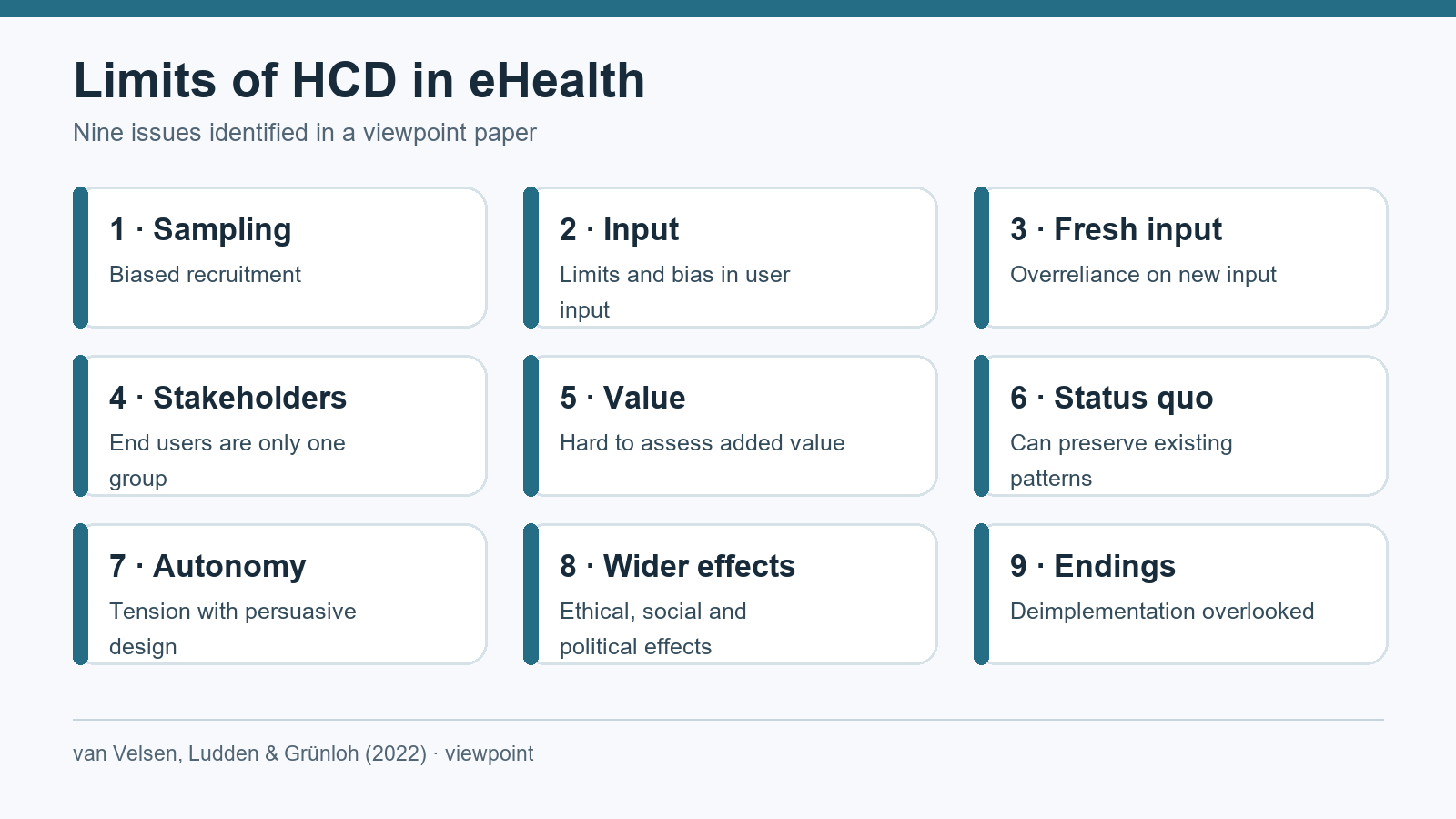
Van Velsen, Ludden and Grünloh (2022) argue that user- and human-centred design (HCD) in eHealth needs critical reflection. Their paper is a viewpoint: its nine limitations are an analytical account, not a comparison trial showing how often each problem occurs.
Nine limitations to watch for
Recruitment can produce a biased sample.
User input can be biased or incomplete, and tacit knowledge is hard to elicit.
Teams may rely too heavily on fresh user input.
End users are only one group among relevant stakeholders.
The added value of HCD can be difficult to assess.
Starting from current experience can preserve the status quo.
Persuasive behaviour-change goals can conflict with user autonomy.
Ethical, societal and political effects can be overlooked.
Projects often plan onboarding but give little attention to endings or deimplementation.
How the authors suggest moving forward
The paper discusses value-sensitive design, citizen science and more-than-human design as ways to widen what design considers. It also asks teams to report difficulties and failures, not only successful processes. These approaches are directions for reflection and research; the viewpoint does not establish that one is superior for a particular eHealth intervention.
Reflection: When reviewing an eHealth design report, which stakeholders and wider effects might be missing from the described user-centred process?
Source: van Velsen, Ludden & Grünloh (2022), “The Limitations of User-and Human-Centered Design in an eHealth Context and How to Move Beyond Them”.
10. User-Centered Design, Activity-Centered Design, and Goal-Directed Design
Compare user-centered design, activity-centered design, and goal-directed design as different ways of framing design work. Learners examine the emphasis each places on people, activities, and goals, then consider when these perspectives may complement one another.
Learning Outcome
By the end of this module, learners will be able to:
- Distinguish user-centered, activity-centered, and goal-directed design by their primary focus.
- Compare how each approach frames design questions and priorities.
- Select and justify an approach, or combination of approaches, for a given design scenario.
Three lenses for design work
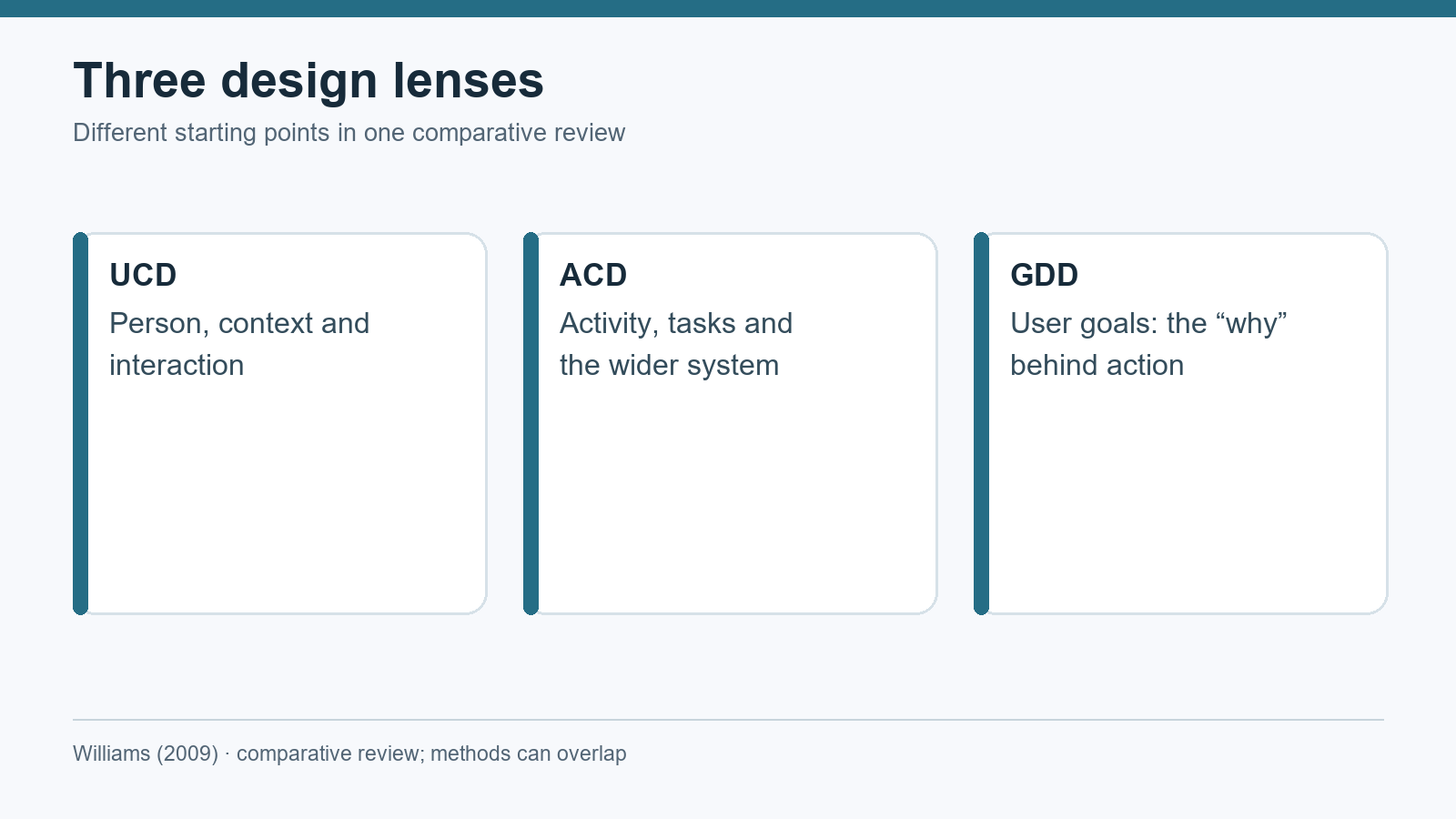
Williams (2009) compares user-centred design (UCD), activity-centred design (ACD) and goal-directed design (GDD). The paper is a comparative review of ideas, processes and deliverables. It does not empirically rank the three approaches.
Where each approach begins
UCD: attends to people, their context and their interaction with a product. The paper describes research, design and evaluation as recurring phases, with outputs such as sitemaps, wireframes and prototypes.
ACD: takes activities and tasks, including the wider sociotechnical system in which they happen, as the main unit of attention. Williams notes that its practitioner process and deliverables are less clearly standardised in the literature she reviews.
GDD: asks what goals people are trying to achieve and why. The paper describes research, modelling, requirements, framework, refinement and support. Personas are especially important in this account.
Use the distinctions as questions
The three approaches share methods and can overlap in practice. The comparison helps a design team ask whether it has understood the person and context, the activity and its system, and the goals behind action. It does not imply that one lens should exclude the others or that the same process fits every project.
Reflection: Looking at a design brief, which question is least answered: who is involved and in what context, what activity is being supported, or what goal motivates it?
Source: Williams (2009), “User-Centered Design, Activity-Centered Design, and Goal-Directed Design”.
11. Final overview
Bring together the learning path’s themes and translate reflection into practical next steps. Learners connect evidence, participatory approaches, and design perspectives to develop a reasoned approach to inclusive youth engagement and interdisciplinary collaboration.
Learning Outcome
By the end of this module, learners will be able to:
- Synthesize lessons on inclusion, youth engagement, and interdisciplinary innovation across the learning path.
- Justify choices about participation, design methods, and evaluation using the evidence reviewed.
- Formulate next steps for applying the learning while acknowledging evidence gaps and contextual limitations.